
10 Common Catholic Stereotypes, Myths, and Misconceptions
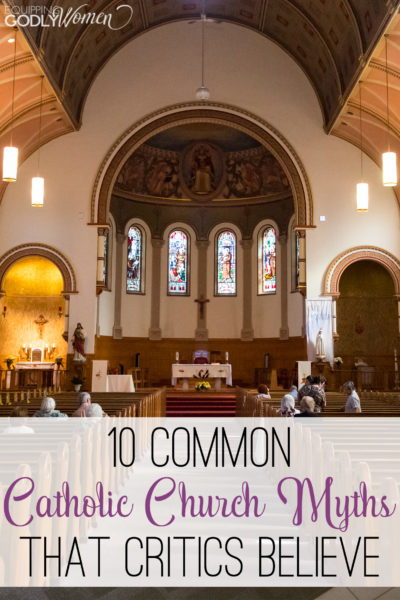
There are lots of wrong ideas about the Catholic Church out there. Are you guilty of believing any of these 10 very common Catholic stereotypes, myths, or misconceptions?
Two years ago, I read a book that would change my perspective on Christianity forever: Surprised by Truth* by Patrick Madrid.
While it (and all of the research I did afterward) wasn’t enough to fully convert me to Catholicism, it did poke some pretty big holes in everything I was taught growing up as a Protestant, and it exposed lots of stereotypes about Catholics that I’d heard.
Things I was so sure of before — basic tenets of my faith — were suddenly glaringly wrong.
It was a pretty tumultuous time, as I reevaluated everything I’d believed my whole life. It was the start of something big, and it was the start of the series you’re reading now.
(You can read the whole series here, if you’re interested.)
Now, two years later, I’m still not fully convinced that Catholic Christianity has it all right. But I’m not convinced they don’t either.
What I do know is that much of what people believe about Catholics and the Catholic church simply isn’t true. Lots of what people “know” aren’t facts — they are Catholic stereotypes that don’t hold up when we dig just a big deeper.
And today, I’d like to set the record straight.
Are you guilty of believing any of these Catholic stereotypes and myths?
*This post contains affiliate links. Please see my full disclosure statement for additional information.
—————————-
A Few Things to Keep in Mind Before We Begin…
1. This post is about official Catholic belief — not what Catholics do in the privacy of their own homes.
What a religion officially teaches and how the people put it into practice are two entirely different things. In this post, I want to replace Catholic stereotypes with accurate information. This post is only meant to talk about what Catholicism actually officially teaches — not what people actually do in the privacy of their own homes or in their local churches.
(There will always be individual people messing things up in every religion)
2. This post is just an introduction to Catholic stereotypes, myths, and misconceptions.
This post is not meant to be an exhaustive guide to everything the Catholic Church teaches and misconceptions about it. That’d be waaaaay too long for a single blog post! It’s simply an overview of 10 of the most common stereotypes about Catholics and their beliefs.
Please see the links below each point to read about each issue more in depth. There are some really great posts in the rest of this series, and they explain these Catholic myths in ways a simple paragraph or two cannot adequately cover.

Want to Explore Catholic Stereotypes in More Depth?
I have a free guide that will help you do just that!
“10 Common Catholic Church Myths that Critics Believe” contains all the Catholic stereotypes from this article so you can print them out, refer back to them, and share them with others.
Plus – it even includes 5 bonus myths not included in this article!
If you are looking for information to help you share with non-Catholic family members OR if you’re thinking about becoming Catholic but you still have some questions about Catholic misconceptions — this is a fantastic resource to have on hand.
—————————-
Alright, let’s dive in!
10 Common Catholic Stereotypes, Myths, and Misconceptions
Myth #1: Catholics Aren’t Christians
Actually, Catholics consider themselves to be the original Christians, who are doing their best to hold to the same beliefs and traditions that the church held to in the first century.
According to Catholics, Catholics and Protestants are all Christians, and both Catholics and Protestants can go to Heaven. The Protestant denominations are simply off-shoots of Catholicism (or of other denominations) that branched off over various disagreements about what the Catholic Church was teaching.
Whether Catholics have held fast to the right teachings throughout the ages or whether they veered off and the Protestant denominations got us back on track — that’s something I’m still trying to discover.
This is a big Catholic myth to kick off this post: Even though Catholic stereotype #1 says that Catholics aren’t Christians, the truth is that Catholics are doing their best to follow the teachings of Jesus Christ (and isn’t that one of the things that makes a Christian a Christian?).
Myth #2: The Catholic Church Abandoned the Bible for Man-Made Traditions
While the Catholic Church does have many traditions that aren’t explicitly found in the Bible, so does every church (and so do you, in your home). Traditions themselves aren’t bad. It’s only when we prioritize them over God himself or when they take us farther away from God instead of drawing us near that they cause problems.
One reason that the Catholic Church has so many traditions is that the first century apostles didn’t write down absolutely every single thing they taught. In fact, John 21:25 tells us,
“Jesus did many other things as well. If every one of them were written down, I suppose that even the whole world would not have room for the books that would be written.”
Catholics do their best to value and uphold both the written and oral teachings that were passed down from the apostles. Protestants look to the written teachings (the Bible) only.
The Catholic Church still highly prioritizes Scripture. It just isn’t their only source of information (and nowhere in the Scriptures does it tell us it should be).
Catholic stereotype #2 tells us that Catholics abandoned the Bible, but the truth is that Catholics use the Bible along with written and oral traditions.
For more on this topic, I’d highly recommend my post Who Has the Ultimate Authority? A Biblical Look at Sola Scriptura. You can also find the explanations for many common Catholic traditions in Why Do Catholics…? Honest Answers to Your Burning Questions.
Myth #3: Catholics Worship Mary / Saints / Statues
It’s easy to see how some Catholic stereotypes (like this one) got started, but again, it really is just another of many misconceptions about the Catholic Church.
Catholics do not worship Mary or statues; they worship God alone.
Instead, they “venerate” Mary, which, according to Google, is just a fancy word for “regard with great respect.” Similar to how we would show great honor or respect to a King or Queen, without actually worshiping them, Catholics hold Mary and other saints in high esteem as good examples of how to live a faithful life.
Yes, to Protestants, the practices definitely look like worship, and it’s easy to understand why this Catholic myth is still around. But since worship is an attitude of the heart, I don’t think you can “accidentally” worship someone and not know it. If Catholics’ hearts are in the right place — and they only want to show honor — then it’s not worship.
And it’s the same with statues as well. Catholics don’t worship statues. Instead, they are used as decorations to help Catholics remember people who have gone before, similar to how you might put pictures of your friends and family on your wall, or even a baseball card collection you may have had as a kid.
You look at them, you remember them, but you certainly don’t worship them.
They’re just decorations or teaching instruments meant to inspire faith.
Sure, Catholics might have statues and talk about saints who lived a long time ago. But contrary to Catholic stereotype #3, the truth is that Catholics honor Mary and other examples of faith (even with statues!) while saving their worship for God alone.
*For more information on this, don’t miss my post Do Catholics Worship Mary, Saints or Statues?
Myth #4: Catholics Believe People are Saved by Works
The Catholic Church does NOT teach that people are saved by their works. In fact, the catechism of the Catholic Church actually specifically forbids this notion.
Rather, the Catholic Churches basically teaches that, “If you call yourself a Christian, but you don’t act like it, maybe you’re not really a Christian after all.” Or, “Yes, God saves you through faith, but it’s a living faith that naturally produces good works.”
This Catholic teaching is actually 100% Biblical (here are plenty of Bible verses that support it), and is even taught by some highly respected Protestant/non-denominational pastors, including the most Godly man I’ve ever heard speak, Francis Chan.
This widespread Catholic stereotype #4 says that Catholics believe they can get to Heaven by earning it through good works. The truth is that Catholics see good works as the Spirit-inspired fruit of a heart saved by God’s grace alone.
*For a more in-depth look at this topic, please see my other posts Is Faith Alone Enough? and Are You a Christian? Are you Sure?
Myth #5: The Catholic Church Added Books to the Bible
The books that are currently in the Catholic Bible are the same books that the church has recognized as being in the Bible for centuries. It wasn’t until the 16th century that Martin Luther and the Reformers moved them to the appendix, before they were ultimately taken out.
(For the record, Martin Luther wanted to remove James, Hebrew, Jude and Revelations as well, but was unsuccessful. The books that he did remove are called Tobit, Judith, 1 and 2 Maccabees, Wisdom of Solomon, Sirach, and Baruch.)
Whether or not the additional books should have been left in or taken out — I don’t know. I wasn’t there. Guess you have to ask yourself if the early church could have been wrong for 1700 years and the Reformers knew better than the earlier Christians did.
Either way, I’ve read through all these additional books, and there really isn’t much surprising in them. They read like pretty typical Old Testament books. There are a few verses about praying for the dead, but other than that, I don’t recall reading anything that stuck out as especially “Catholic.”
This Catholic stereotype #5 is a doozy because the truth is actually the opposite — one man decided to take out some books that had been in the Bible for over a thousand years.
*For more information, don’t miss my post on Martin Luther, the history of the Catholic Church, and the Bible books issue.
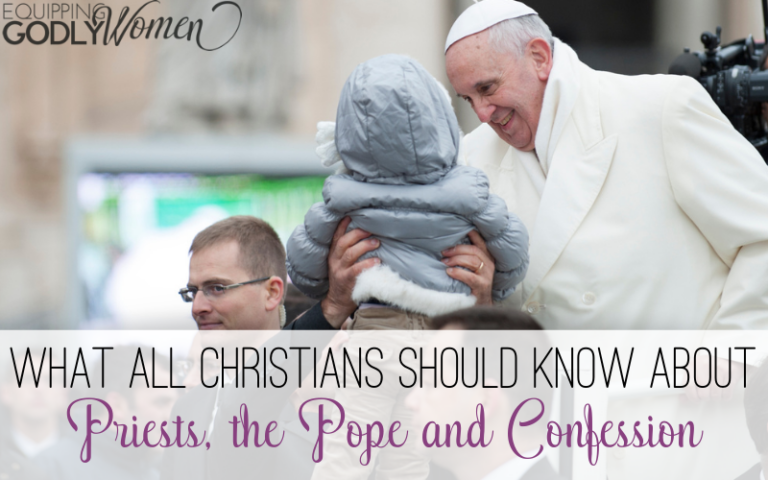
Myth #6: Catholic Priests Can’t Be Married
(Some) Priests are married! Some even have children and grandchildren. (This happens when a man is already married and a priest in a different denomination and then converts to Catholicism later.)
And of those who become priests the usual way and aren’t allowed to get married–not all of them even want to be. Priests know what they’re signing up for. No one is making them be a priest. They have a choice between God and a wife, and it is their choice to make. No one is forcing them to choose one or the other.
Catholic stereotype #6 is in fact the general rule — but the bigger truth is that the path of some Catholic priests does allow them to marry a woman. And those who don’t often consider themselves to be married to the church, the Bride of Christ.
*For more information, read my post on priests, the Pope and confession.
Myth #7: Catholics Recrucify Jesus at Mass
I haven’t heard this Catholic misconception in real life, but apparently it’s popular. Catholics do not re-crucify Jesus at Mass.
Instead, they believe that Jesus and the crucifixion occur outside the limits of time (because God can do cool stuff like that), and so when they celebrate Mass, they are only making the sacrifice (which has already occurred) “present” on the altar.
While Catholic stereotype #7 imagines Catholics as recrucifying Jesus at Mass, the truth is that Catholics believe they are making the eternal reality present in our non-eternal timeline at Mass.
*For a very interesting and in-depth look at the Eucharist, be sure to check out my post Is the Eucharist Really Just a Symbol? 5 Convincing Proofs that Say that It’s Not.
Myth #8: Catholics Believe Only Catholics Can Go to Heaven
While Catholics do believe their religion is the one true religion and the ordinary (most common) means of bringing people to salvation, it is a common Catholic misconception that they believe this is the only way. Instead, they recognize that God can use any means He wants to to bring people to Himself, including those other than the Catholic church, especially if the person has never had the opportunity or knowledge to join the church.
They believe that Protestants who have no reason to suspect their beliefs are incorrect can go to Heaven, as well as Protestants who were planning to convert before death but hadn’t done so yet.
Furthermore, Catholics do not believe you can say with 100% certainty who will go to Heaven (though you can have a good idea) simply because God is judge and we are not — and who are we to presume to know His thoughts?
Even though Catholic stereotype #8 imagines Catholics as very close-minded about the salvation of others, the truth is that Catholic teaching leaves lots of room for God’s grace to work in every single person’s salvation.
Myth #9: Catholic Priests are Child Molesters
Yes, the Catholic church has had huge and horrible scandals in which some priests were molesting children. This was absolutely awful and shameful, and they will have to stand before Jesus for what they did. That part is not one of the myths about the Catholic Church.
But if you look at the statistics, only a very small minority of priests were involved, and it isn’t really fair to blame the entire Church or dismiss the Church’s core teachings for what a few did. Scandals like this happen in EVERY church and in every city. That doesn’t make everyone guilty of the crimes of a few, and it does NOT mean that innocent Catholic priests deserve negative treatment today because of this stereotype.
It is heartbreaking that Catholic stereotype #9 does have some truth to it — some Catholic priests have molested children. But the truth is that the vast number of priests are men who serve God humbly and who shepherd their flock instead of harming the sheep.
*For more information, be sure to check out my series post on priests, the pope and confession.
Myth #10: The Catholic Church is Anti-Women
The church isn’t anti-anyone. They do believe birth control is morally wrong — the same thing every denomination believed until 1930. But when pretty much every other denomination began to change its mind, the Catholic church held its ground on this teaching. They continue to teach the same thing today, even when this gets interpreted as an “anti-woman” Catholic misconception.
The Catholic church also doesn’t allow women to be priests, which has upset many. But if you look at their rate of women in non-priest leadership positions, it is WAY higher than average. The Catholic church may not do things the “feminist” way, but they do hold women in very high esteem, even referring to them as the “crown of creation.” That’s pretty special if you ask me 🙂
So while Catholic stereotype #10 paints the Catholic church as an “anti-woman” institution, the truth is that many women are in leadership positions in the Catholic church, and the Catholic church holds women in very high regard.
Like I said earlier, the intent of this post is ONLY to dispel a few stereotypes about Catholics so that, going forward, your thoughts and opinions aren’t swayed by misinformation. I’m not trying to convert or persuade, just to present you with some information about Protestant and Catholic beliefs so YOU can make an informed decision of your own. 🙂
Ready for more? You can read through the rest of the posts in this Catholic vs Protestant series here OR see what I ended up deciding in my latest Catholic update post here.
I’d love to hear your thoughts and opinions on these Catholic stereotypes and myths, or others you’ve heard! Leave me a note (or a book 🙂 ) in the comments section below!
—————————-
Ready for More?
Honestly, these 10 stereotypes are just the start. Download the print version to get a handy guide you can refer to later or share with others AND get 5 bonus Catholic myths that aren’t included in this article!





Hi Brittany! What a tremendous post! Exceptional! I was raised Protestant and my husband was raised Catholic. We are not Catholic now but we have benefited so much from the Catholic Church that I was so happy to see you post this…TRUTH is often hard to come by! Thank you for taking the time to get it right!
I am curious if you don’t mind sharing–why are you not Catholic now? Is there a particular reason? And I can’t promise I’ll get it 100% but I’m sure trying my very best!!
Hi Brittany! First, I want to thank you for your posts, and for your openness in sharing your journey. It can be a very personal thing, but what you are doing will help many. I am Catholic, have been my whole life. At some points my ferver for my Faith has been stronger than others, as happens to many in their faith life, but I have always loved the beauty and the richness of the Church. I have also found that anytime I have had a question or concern, there is always a place to find the answer. I trust the Church’s teachings, as they are very difficult to refute when done humbly with an open mind AND heart. I will pray for you on your journey. It may be quite difficult at times, but just keep your eyes on Jesus and pray pray pray!! :). I do want to mention, I didn’t see anything (maybe I missed it) about the Eucharist in these posts. Where do you stand on belief in regards to Christ being present in the Eucharist. This is the source and summit of our faith. It is what keeps me firmly planted where I am, as nothing could ever cause me to walk away from Him. Just wondering where you are with this? Oh, and I second the comments and posts about reading Scott Hahns books (or listening to his cd’s in the car is fun too!) My husband was not Catholic when we got married. After a while he started going to some of Scott’s talks with me…as well as some other speakers like Tim Staples, Alex Jones, Jeff Cavins, and Fr. Larry Richards). He found truth in what they were saying, and although he was adamant about not becoming Catholic at first, eventually he said he came to realize the Church has the fullness of the faith. He became Catholic the year our first child was born. I think you will find Scott Hahns books very helpful. His conversion story is “Rome Sweet Home” His wife, Kimberly, had a much harder time with her conversion, and many can relate to her story. Also, there is a series done by Fr. Robert Barron called “Catholicism”. It is a phenomenal DVD set that walks you through the Catholic faith. It’s been on TV too. I have an extra set of this series I would be happy to let you borrow if you would like. I could mail it to you. I also have a bunch of different Scott Hahn (and others) books or CD’s I’d be happy to share! Either way, God bless you on your journey…and know that you have many peoples prayers that God leads you where He wants you to be. I look forward to reading more!!
Hi, Michelle! Thanks for taking the time to respond! I didn’t include the Eucharist in this post because it isn’t really a myth–both Catholics and Protestants generally have a good understanding of WHAT the other believes, even if they don’t know why or don’t agree. But, you’re right, it is a huge teaching and it’s the one I’ll be covering next week! Hope to see you then!
Just wanted to let you know that the post covering the Eucharist is now live. You can find it here: https://equippinggodlywomen.com/faith/is-the-eucharist-really-just-a-symbol/. Hope that answers your questions 🙂
The book “Rome Sweet Home” by Scott Hahn is a very good read about a Presbyterian ministers journey. As he climbs through the ranks of his church he begins to question things they do and things they incorrectly assume about Catholics. It explains the Catholics beliefs and traditions while pointing to where it relates in the bible. He was on his way to assume a high position in his church and his journey led him to be one of the strongest voices out there for the Catholic church.
Thanks for the tip, Felix! I have read Rome Sweet Rome (in fact, its on my bedside table right now). I thought it was a little low on the diving in and explaining why, but their story was very interesting and helped me feel better about my own.
I agree with you on ‘Rome, Sweet Rome’. Powerful, but light on biblical emphasis, which is implied by his knowledge and amount of research he did. That is why I seldom recommend it for those that are deep into biblical and historical reasoning. There are other choices that dive into that area much more thoroughly. I know you stated that most of your research has been done, but I also notice lots of questions. So, I hope these recommendations help.
There are some gems out there that do this. For a more biblical approach I feel that David Currie’s “Born Fundamentalist, Born Again Catholic” is far better. It is his conversion but much more meaty in all subjects.
For Baptism and the Eucharist, Steve K. Ray’s “Crossing the Tiber” is more like ‘scripture analysis’, after a chapter on his conversion. I also hold his other book “Upon This Rock” as well researched in seeking and supporting the papacy; a surmountable obstacle for many.
To know what the early church/Christians believed and the Church Fathers, which is what you are trying to do also, I recommend these: Jimmy Akin’s “The Fathers Know Best”, Michael O’Brien’s “Theophilos”, and Rod Bennett’s “Four Witnesses: The Early Church in Her own Words”. I have known for many years and I am familiar with Jimmy’s work (outstanding). I came across Bennet’s work lately, and not only is it thorough, but a true joy to read or listen to (I have heard from those who bought the audio version of the book). O’Brien’s is the only one I have not read, but he comes highly recommended and is lumped together with Akin and Bennett by those that have read all three. He is next on my list of books.
For the Communion of Saints (praying to/with the saints) the most thorough is Patrick Madrid’s “Any Friend of God is a Friend of Mine”. It is a fairly small book, but very dense, and covers ‘all’ corners.
Regarding the Catholic Rites (the variety of Liturgical expressions within the Church) I think you may find this conversion story in the Coming Home Network by a Ukrainian Byzantine priest most illuminating. He struggle with ‘where’ to serve the Church and he talks a bit about the rites in a most beautiful way (toward the end). Here is the link:
https://www.youtube.com/watch?v=rQCD4jKHeOU
I hope, if these are not on your list of must haves, that you consider these recommendations to dig in when you have more time. I remember when I did my journey (I love the truth), as I began to sift through the ‘obvious’ errors and then dove deeper into learning and gained a thorough understanding of things, it became an unquenchable thirst for Truth that lasted roughly 18 months.
Since your desire is Truth, I am afraid you have probably embarked in a similar journey. In the end we know in our hearts and souls that Absolute Truth exists. The question is if we can find it and encounter it here on earth during our lifetime, and the answer is yes. Jesus! But ‘which’ Jesus?
The Muslims worship the God of Abraham. The Jews also worship the God of Abraham. Similarly, the Samaritans, the Catholics, the Orthodox, smaller ancient heretical groups that have survived, the wide array and flavors of ‘born-again’ Christians, the Mormons, the JW, and Unitarians also worship the God of Abraham.
The God of Abraham is believed by all to be THE Absolute Truth, yet all views differ from minor to substantial, and radical. When we look at Christianity, this is a similar dilemma, but in a narrower sense, where Jesus is the focal point.
Just thought I would give some ‘food for thought’, which I had to digest myself years ago.
In my prayers.
What would you say of a man who was given a wrecked car and told to restore it to the same condition as it was before the wreck, only to return to you half-done? You certainly wouldn’t think very much of his workmanship and you would probably warn your friends and co-workers to avoid his shop at all costs. A job half-done is a job not done at all.
Yet this is exactly what Protestantism teaches about the Redemption of our Lord in denying the Queenship of our Lady and Her right to our honor. This problem comes from the highly individualized view of salvation extant in Protestantism. Everything is viewed from the aspect of “what’s in this for me?” instead of the overview of God’s salvific work in all of Creation. It is a very truncated and narrow view of God’s redemptive work.
The Last Adam as man does what first Adam failed to do. The first Adam, through his sin, forfeits the possibility of becoming everything that the Last Adam does become. In Christ Jesus, every effect of the Fall is reversed and all that mankind possesses in the Garden is restored. Rev. Ralph Smith, a Reformed writer, states the same thing:
“It is what salvation is all about because salvation is restoration – not merely restoration to the original state in Eden but to the attainment of the goal of Eden.”
This is an amazing statement, but Rev. Smith has not followed his thinking to the logical outcome. There was another person in the Garden. The covenant helpmeet. What of her? If Eve is not restored in full, then the work of God’s redemptive plan is only half done. Everything must be restored completely to the condition that it was in before the Fall. Before the Fall, there was a human mother of all with a nature uncorrupted by sin and the possibility of becoming a queen next to her king husband. If God restored Adam as male human being, then in order to fully restore that which He created in the Garden, He must also restore Eve in the person of a female human being. To leave Eve out of the equation would be to leave the redemptive work of the Father incomplete. There would be no regeneration. Certainly the Early Church Fathers understood this, for they referred to the Blessed Virgin as the New Eve.
Let’s look at some of the parallels between Eve and Mary, beginning with their creation as human beings.
Eve was created by the work of God in splitting open Adam’s side. The Blessed Virgin was created in the same way, by the splitting open of the side of the Last Adam. Both were created sinless. The difference is, of course, that Eve had no sin in her creation, while Mary, on the other hand, required a blood sacrifice to entirely cleanse Her at the moment of Her conception. I find it interesting that in both cases, we see the shedding of blood, which is always part of a covenant cutting ritual. Without the death of Christ for sin, His covenant Blood could not have been applied to Mary for her original sin at the instant of her conception to make her created in the exact same way that Eve was – innocent and sinless.
Eve was the wife of a prince. As son of the Great King – God – Adam had kingship and rulership in front of him, which means that Eve would have been a queen to rule with him.
Since the Bible portrays the Church as the Bride of Christ, this Marian image is certainly related to and appropriated from that one. Building on the biblical image of Christ as the “Last Adam,” early Christians spoke of a “New Eve,” a feminine cooperator with Jesus in the economy of the redemption. Second century writers Saints Justin Martyr and Irenaeus of Lyons perceived Mary as this second Eve, who undid the sin of the first one:
“Christ became man by the Virgin that the disobedience which issued from the serpent might be destroyed in the same way it originated. Eve was still an undefiled virgin when she conceived the word of the serpent and brought forth disobedience and death. But the Virgin received faith and joy, at the announcement of the angel Gabriel…and she replied, “Be it done to me according to your word”. So through the mediation of the Virgin he came into the world, through whom God would crush the serpent and those angels and men like him, who delivers from death those who turn from their evil ways and believe in him.”
“The seduction of a fallen angel drew Eve, a virgin espoused to a man, while the glad tidings of the holy angel drew Mary, a Virgin already espoused, to begin the plan which would dissolve the bonds of that first snare…For as the former was led astray by the word of an angel, so that she fled from God when she had disobeyed his word, so did the latter, by an angelic communication, receive the glad tidings that she should bear God, and obeyed his word. If the former disobeyed God, the latter obeyed, so that the Virgin Mary might become the advocate of the virgin Eve. Thus, as the human race fell into bondage to death by means of a virgin, so it is rescued by a virgin; virginal disobedience is balanced in the opposite scale by virginal obedience.”
In like manner, the Blessed Virgin, as the new Eve to the Last Adam, is the helpmeet. She bears rulership with Him, not of herself intrinsically, but of God, in the same way that Adam and Eve would have borne the authority of God had they not fallen. When titles such as Intercessor, Mediator, and others which drive Protestants just wild, are given to her, they are given because she, as helpmeet, equally bears that authority that her human son, the Last Adam, has been given in heaven.
Remember, it is a man who rules in heaven. Yes, a special man who is, in a mystery both human and divine, two natures not co-mingled, yet existing in one person – a man. A man and a woman – a human king and queen in heaven ruling as the covenant heads of the family. This was exactly what God had planned for Adam and Eve and exactly what He restored in Jesus and the Virgin Mary – Kingship and Queenship over the created world.
So far, I have been adding comments as replies and clarifications from someone who is Catholic and did a lot of studying and dialogue with non-Catholic Christians also.
Your endeavor is a wonderful one, and I will be praying for the Lord to guide you where He wants you to serve Him. I do hope it be the Catholic Church in the end, because I have come to believe with all my heart and mind to be the “Bulwark and Foundation of Truth”, but His ways are far above mine.
I will be praying the Lord may help you with discernment, wisdom, and humility. I will also pray that He grants you the graces you will need to understand the seamless, yet complex faith that is the Catholic Faith. So complex that you could spend a lifetime exploring it, yet so simple that a little child grasps readily. And finally, that the perspective that you have been trained to see and understand things may not hinder you from seeing the beauty that the Lord wants you to see and experience.
ps: Recommendation = Relax on the deadlines. You may not be able to do justice on some topics if you put yourself against a corner. Let the Lord guide and lead you.
I remember when I did my digging, I was spending 16 to 18 hours every day absorbed by the insatiable quest for Truth which took me almost two years. Then tapered off for another year.
Thanks for the prayers, Antonio. I’ve already done much of the research–now I just need to type everything up. Not that I know anywhere near enough (or ever will). My purpose isn’t to provide every single irrefutable detail though–just to share my store and provide a foundation that will encourage others to examine the truth for themselves.
Understood.
Will be praying that the Lord may guide you on your writing and touch others.
Like you, I was raised in a Protestant tradition, and have attended the Catholic church for most of my 27 years of marriage. We raised our children to be ‘Christian.’ Also like you, I have worked to reconcile much of what I was taught about the Catholic Church while growing up – especially a lot of propaganda which was spouted in one particular denomination which shall not be named. I now see myself as a catholic (small-c intentional) Christian built upon a strong Mennonite Christian foundation.
Too many people view their particular Christian perspective (or church/denomination) like a football team. i.e. – I used to be a Methodist, but now I am a Catholic — kind of like ‘I used to be a Bronco’s fan, but now I am a Redskins fan.’ I believe such language gives us all the wrong idea about Christianity. Denominational perspectives are not in competition with each other. We are all Christians who should be focused on finding the truth – not denominational cheerleaders trying to outdo each other. I believe such a focus is really the very clever work of the devil.
In fact, I also believe that our overuse of the word ‘religion’ when we really mean ‘Christian tradition’ is also the work of the devil. Think of how casually you say, ‘Catholic religion’, or ‘Protestant religion’, or ‘Lutheran religion’ when discussing different Christian traditions. Use of the word ‘religion’ in this context implies that these different Christian perspectives have ‘religion’ status relative to each other. That is not the case. Christianity is a religion – as opposed to Islam, which is an entirely different religion. Catholicism is a particular Christian tradition/perspective with a deep history. The Lutheran perspective has its own particular Christian perspective and history – but it is not sufficiently different from Catholicism to warrant separate ‘religion’ status. So – the devil has effectively divided us…and thus conquered in a very effective way. If he can keep us focused on arguing with each other about who is more ‘right’, then we are not spending our time focusing on the message of Jesus Christ.
A very good way to introduce a Protestant to the history of the Catholic tradition is to say, ‘the first 1,500 years of Christianity were under the leadership and guidance of the Catholic church. These Catholic ‘faith ancestors’ and this Christian history belongs to you just as much as it does to me. I would love to introduce you to some of your Christian ancestors – the fathers of the Church.’ This is a much better approach than, ‘our Church was founded by Jesus Christ’ – which implies that their church was not – and now you have just started a fight and the devil has won.
I applaud your efforts to combat these misrepresentations about the Catholic tradition. There are plenty of misrepresentations about the various Protestant Christian perspectives which need to be addressed as well. Hopefully someday we can all just focus on living as Jesus called us to live.
Hi, James! Agreed. As I’ve told many others, I’m not seeking a denominational label. Just searching out the truth wherever I can find it. The labels are helpful for providing a framework, but they definitely aren’t meant to be confining, if that makes sense. It’s not a competition, but a journey towards the truth.
I love how you so casually and cavalierly gloss over priest pedophilia. “Scandals in *every* church!” Give me a break. The Catholic church shuffled pedo priests from parish to parish for decades, aware of the atrocities being committed by supposed men of God. The Vatican knew and did *nothing* to stop this. Cardinals knew and did nothing. Bishops and Archbishops knew. They did nothing. Please tell me again how “it isn’t really fair to blame the entire Church or dismiss the Church’s core teachings for what a few did.” Better yet, tell the victims.
I cannot even image the horror that the victims experienced. It’s absolutely heartbreaking, and I don’t mean to gloss over it. But ultimately, it is the individuals involved who were responsible (including those who did things and those who failed to). Just like in our country–we have murderers, thiefs, etc. There are plenty of bad people and plenty of people who do nothing to stop it. It doesn’t make American laws bad because the people don’t follow them. It makes the people bad. Similarly, it doesn’t make Catholic beliefs wrong because of the people who didn’t follow them. If the official church teaching was encouraging this–that’d be totally different. Instead, it was a minority of the people in the church who did NOT listen to church teaching. I hope that makes sense.
Your blog would have been strengthened had you worded that section closer to what you said here. Thanks for your reply.
How can anyone have faith in a church who actually, from the top down, hide and protect criminals? To compare the rape and homosexual abuse of innocent children in the RCC, with civilian crimes is almost being dismissive. The point is really: what kind of church spends millions of $ hiding criminal ‘priests’. The popes themselves were aware of these goings on for decades. These are not your average on-the-street civilian, these are people who claim they are doing God’s work and (in the case of the pope) speak on behalf of God, and entrusted with authority over innocent children! May I ask you a question? Do you think your response would be quite so mild and understanding if it were your children that had been sexually abused?
The same way we can have faith in our country. There are a TON of crooked politicians in America. Does that make the principles that founded this country invalid? Does that make every politician or every American a criminal–just because some are? I’m not saying there isn’t blame here–just that it needs to be rightly placed.
And if it were my children, I am sure it would change my perspective in that I would be more saddened, more outraged, more determined for change. BUT, no, I honestly do not believe it would change my perspective on the church in general. The actions of the portion of people who did NOT follow the church’s teaching don’t invalidate the teachings.
To give an example: Say you had a medicine. One person took it, the other didn’t. The one who took it lived. The one who didn’t died. You wouldn’t say “What a horrible medicine–the second person died!” Well… he didn’t take it. It’s the same here. The fact that the priests didn’t follow the teachings and then horrible things happened doesn’t reflect on the teachings that they weren’t following. If the official church teachings said to do this, that’d be different. But there’s a big difference between what the church officially teaches and what people do in real life. And I think that distinction is crucial.
I think your point Bob G. is interesting.
Last year, between January and April there were 120+ sexual abuse cases in the school systems. Some Representative from the House of Reps, can’t remember his name, wanted to introduce a law that the victims could sue the schools for not doing better at protecting the children. During that time, one priest was accused in the USA. Anyway, the law *never* saw the light of day.
Here is another one that is a real beauty. If you do a search for ‘pastor charged with sexual’ you will get a ton of Protestant pastors that were charged within the last week or two.
Last year, on the month of June (could have been May) there were 25 or 26 pastors charged with sexual assault of minors and children. Of all of those, *only ONE* was a Catholic priest, the rest were a variety of Christian pastors and ministers. I remember when there were all the news about the Catholic priests, there was a non-Catholic pastor that was charged with *over* 130 counts of sexual assault on children and minors. He had been doing some church *hopping*.
Doesn’t it make you wonder why such difference in news coverage? If it is a Catholic priest, he gets *national* and *international* spotlights on the news, but if it is 20+Protestants that are arrested in a month (some with a *much* greater number of assault charges than any priest), they make the local news, and very few people are aware of it. Don’t you *hate* double-standards?
Just wondering. Have you heard about any of these other Christian pastors?
Anything about all these latest ones?
Don’t you think that those 20+ in one month should have made the *big* news? I would imagine so.
Ooops. Forgot!
They are *not* Catholic.
How about all these non-Catholic pastors that were arrested for sexual assaults on children in the last couple of weeks. Did you hear anything about it?
The way you are talking and condemning the Catholic faith for it’s sinners, then *every body* should leave their churches and Christianity altogether because sexual corruption is everywhere.
What about the Council at Nicea where they decided arbitrarily what was to be included in “the official Bible” and what was not?
Its all made up as Fredric Niche said: ” Organized religion is a natural psychological phenomenon used to by oppressed people, long enslaved to make sense of their suffering. Justice would be meted out in the “nether-world” to those who oppressed them in order to balance the scales.
When you die, you are dead. Just like the dandelion in your garden. You had your shot at life, you lived it and now you’re gone.
I’d love it if there were a heaven where we all would party and love one another after all this, but I’m partying now and loving now. Just sayin!
Well, the issue of whether or not there’s even a God at all is a topic for a whole other series (and one I’d like to do this summer. There really is logical proof behind our beliefs!) For this series, however, we are simply starting with the assumption that there is a God and that Christianity is true. Now we’re just hammering out the details…
Gary, the Council of Nicea had nothing to do with the Cannon of Bible. You have your info mixed up. Sorry to hear you don’t believe in God. You remind me of a young man that was in college with me back in 2002. Born into an atheist family, claimed to be an atheist. There were some one-of-a-kind events that took place between the two of us that changed him completely and deepened my faith. We seldom talked religion or God because it would have been a complete waste of my time. The very last conversation we had, as I was walking away I said to him: “I will be praying for you, J … !”
And he replied in a loud voice, since the distance was increasing (outdoor college campus): “I will pray for you too!”
I am going to give you a challenge, and I hope you have the ‘courage’ (the guts) to take it on. Her is the challenge:
Every day ask God to show you He exists. Ask Him to give you a sign that you cannot refute.
But there is a catch to this; the responsibility of your response. When the time comes, I have absolute confidence that God will provide you with some proof of His existence which will be irrefutable in ‘your heart and mind’. This will be a decisive moment for the rest of your life. Your freedom to chose and accept or reject what you will witness/experience will determine your eternity. I will keep you in my prayers, Gary.
FYI: From your quote of Niche, he has no idea either why or what I believe. To show how far off the mark he is, let me make an analogy. If he was a sniper on a roof top with a rifle and scope, he would miss every single shot, and the enemy would be walking around without worries. Bad philosophers usually ASSUME what the argument is, but some are so arrogant that they don’t even bother to study beforehand what it is. That is a fallacy in philosophy. Do you remember Philosophy 101? It is there. Clue = str…
Niche is very influential with some, but he missed the mark on that one.
Thank you for starting this series! I grew up Protestant, but converted to Catholicism a few years ago? I had many questions, some of which you addressed here, and asked many questions and listened intently to homilies on these questions.
One was about works. When I walked into Mass and the priest talked about works, I listened. It’s the same as in many Protestant Churches, Faith in Jesus is what gets you into Heaven. Works is glorifying God in what we do!
I’m looking forward the rest of your articles.
Thanks Carol!
Just to clarify some of your responses to the myths since you are still on your journey.
1. Catholic priests can’t marry. That one is not a myth. Once a man is ordained a deacon (all priests are first ordained deacons) he is no longer free to marry. However, a married man (in the Eastern Churches and former Anglican/Lutheran ministers in the West) can be ordained to the priesthood. In short hand … a married man can be ordained but an ordained man cannot marry.
2. The Church is not opposed to “birth control” but only certain methods of birth control. There are methods of birth control that are morally acceptable (and effective)
.
Thanks for the clarification. I edited the post a little bit to make it more clear.