
10 Common Catholic Stereotypes, Myths, and Misconceptions
There are lots of wrong ideas about the Catholic Church out there. Are you guilty of believing any of these 10 very common Catholic stereotypes, myths, or misconceptions?
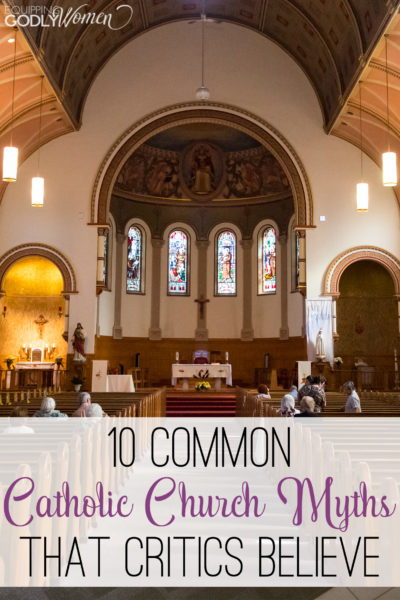
Two years ago, I read a book that would change my perspective on Christianity forever: Surprised by Truth* by Patrick Madrid.
While it (and all of the research I did afterward) wasn’t enough to fully convert me to Catholicism, it did poke some pretty big holes in everything I was taught growing up as a Protestant, and it exposed lots of stereotypes about Catholics that I’d heard.
Things I was so sure of before — basic tenets of my faith — were suddenly glaringly wrong.
It was a pretty tumultuous time, as I reevaluated everything I’d believed my whole life. It was the start of something big, and it was the start of the series you’re reading now.
(You can read the whole series here, if you’re interested.)
Now, two years later, I’m still not fully convinced that Catholic Christianity has it all right. But I’m not convinced they don’t either.
What I do know is that much of what people believe about Catholics and the Catholic church simply isn’t true. Lots of what people “know” aren’t facts — they are Catholic stereotypes that don’t hold up when we dig just a big deeper.
And today, I’d like to set the record straight.
Are you guilty of believing any of these Catholic stereotypes and myths?
*This post contains affiliate links. Please see my full disclosure statement for additional information.
—————————-
A Few Things to Keep in Mind Before We Begin…
1. This post is about official Catholic belief — not what Catholics do in the privacy of their own homes.
What a religion officially teaches and how the people put it into practice are two entirely different things. In this post, I want to replace Catholic stereotypes with accurate information. This post is only meant to talk about what Catholicism actually officially teaches — not what people actually do in the privacy of their own homes or in their local churches.
(There will always be individual people messing things up in every religion)
2. This post is just an introduction to Catholic stereotypes, myths, and misconceptions.
This post is not meant to be an exhaustive guide to everything the Catholic Church teaches and misconceptions about it. That’d be waaaaay too long for a single blog post! It’s simply an overview of 10 of the most common stereotypes about Catholics and their beliefs.
Please see the links below each point to read about each issue more in depth. There are some really great posts in the rest of this series, and they explain these Catholic myths in ways a simple paragraph or two cannot adequately cover.

Want to Explore Catholic Stereotypes in More Depth?
I have a free guide that will help you do just that!
“10 Common Catholic Church Myths that Critics Believe” contains all the Catholic stereotypes from this article so you can print them out, refer back to them, and share them with others.
Plus – it even includes 5 bonus myths not included in this article!
If you are looking for information to help you share with non-Catholic family members OR if you’re thinking about becoming Catholic but you still have some questions about Catholic misconceptions — this is a fantastic resource to have on hand.
—————————-
Alright, let’s dive in!
10 Common Catholic Stereotypes, Myths, and Misconceptions
Myth #1: Catholics Aren’t Christians
Actually, Catholics consider themselves to be the original Christians, who are doing their best to hold to the same beliefs and traditions that the church held to in the first century.
According to Catholics, Catholics and Protestants are all Christians, and both Catholics and Protestants can go to Heaven. The Protestant denominations are simply off-shoots of Catholicism (or of other denominations) that branched off over various disagreements about what the Catholic Church was teaching.
Whether Catholics have held fast to the right teachings throughout the ages or whether they veered off and the Protestant denominations got us back on track — that’s something I’m still trying to discover.
This is a big Catholic myth to kick off this post: Even though Catholic stereotype #1 says that Catholics aren’t Christians, the truth is that Catholics are doing their best to follow the teachings of Jesus Christ (and isn’t that one of the things that makes a Christian a Christian?).
Myth #2: The Catholic Church Abandoned the Bible for Man-Made Traditions
While the Catholic Church does have many traditions that aren’t explicitly found in the Bible, so does every church (and so do you, in your home). Traditions themselves aren’t bad. It’s only when we prioritize them over God himself or when they take us farther away from God instead of drawing us near that they cause problems.
One reason that the Catholic Church has so many traditions is that the first century apostles didn’t write down absolutely every single thing they taught. In fact, John 21:25 tells us,
“Jesus did many other things as well. If every one of them were written down, I suppose that even the whole world would not have room for the books that would be written.”
Catholics do their best to value and uphold both the written and oral teachings that were passed down from the apostles. Protestants look to the written teachings (the Bible) only.
The Catholic Church still highly prioritizes Scripture. It just isn’t their only source of information (and nowhere in the Scriptures does it tell us it should be).
Catholic stereotype #2 tells us that Catholics abandoned the Bible, but the truth is that Catholics use the Bible along with written and oral traditions.
For more on this topic, I’d highly recommend my post Who Has the Ultimate Authority? A Biblical Look at Sola Scriptura. You can also find the explanations for many common Catholic traditions in Why Do Catholics…? Honest Answers to Your Burning Questions.
Myth #3: Catholics Worship Mary / Saints / Statues
It’s easy to see how some Catholic stereotypes (like this one) got started, but again, it really is just another of many misconceptions about the Catholic Church.
Catholics do not worship Mary or statues; they worship God alone.
Instead, they “venerate” Mary, which, according to Google, is just a fancy word for “regard with great respect.” Similar to how we would show great honor or respect to a King or Queen, without actually worshiping them, Catholics hold Mary and other saints in high esteem as good examples of how to live a faithful life.
Yes, to Protestants, the practices definitely look like worship, and it’s easy to understand why this Catholic myth is still around. But since worship is an attitude of the heart, I don’t think you can “accidentally” worship someone and not know it. If Catholics’ hearts are in the right place — and they only want to show honor — then it’s not worship.
And it’s the same with statues as well. Catholics don’t worship statues. Instead, they are used as decorations to help Catholics remember people who have gone before, similar to how you might put pictures of your friends and family on your wall, or even a baseball card collection you may have had as a kid.
You look at them, you remember them, but you certainly don’t worship them.
They’re just decorations or teaching instruments meant to inspire faith.
Sure, Catholics might have statues and talk about saints who lived a long time ago. But contrary to Catholic stereotype #3, the truth is that Catholics honor Mary and other examples of faith (even with statues!) while saving their worship for God alone.
*For more information on this, don’t miss my post Do Catholics Worship Mary, Saints or Statues?
Myth #4: Catholics Believe People are Saved by Works
The Catholic Church does NOT teach that people are saved by their works. In fact, the catechism of the Catholic Church actually specifically forbids this notion.
Rather, the Catholic Churches basically teaches that, “If you call yourself a Christian, but you don’t act like it, maybe you’re not really a Christian after all.” Or, “Yes, God saves you through faith, but it’s a living faith that naturally produces good works.”
This Catholic teaching is actually 100% Biblical (here are plenty of Bible verses that support it), and is even taught by some highly respected Protestant/non-denominational pastors, including the most Godly man I’ve ever heard speak, Francis Chan.
This widespread Catholic stereotype #4 says that Catholics believe they can get to Heaven by earning it through good works. The truth is that Catholics see good works as the Spirit-inspired fruit of a heart saved by God’s grace alone.
*For a more in-depth look at this topic, please see my other posts Is Faith Alone Enough? and Are You a Christian? Are you Sure?
Myth #5: The Catholic Church Added Books to the Bible
The books that are currently in the Catholic Bible are the same books that the church has recognized as being in the Bible for centuries. It wasn’t until the 16th century that Martin Luther and the Reformers moved them to the appendix, before they were ultimately taken out.
(For the record, Martin Luther wanted to remove James, Hebrew, Jude and Revelations as well, but was unsuccessful. The books that he did remove are called Tobit, Judith, 1 and 2 Maccabees, Wisdom of Solomon, Sirach, and Baruch.)
Whether or not the additional books should have been left in or taken out — I don’t know. I wasn’t there. Guess you have to ask yourself if the early church could have been wrong for 1700 years and the Reformers knew better than the earlier Christians did.
Either way, I’ve read through all these additional books, and there really isn’t much surprising in them. They read like pretty typical Old Testament books. There are a few verses about praying for the dead, but other than that, I don’t recall reading anything that stuck out as especially “Catholic.”
This Catholic stereotype #5 is a doozy because the truth is actually the opposite — one man decided to take out some books that had been in the Bible for over a thousand years.
*For more information, don’t miss my post on Martin Luther, the history of the Catholic Church, and the Bible books issue.
Myth #6: Catholic Priests Can’t Be Married
(Some) Priests are married! Some even have children and grandchildren. (This happens when a man is already married and a priest in a different denomination and then converts to Catholicism later.)
And of those who become priests the usual way and aren’t allowed to get married–not all of them even want to be. Priests know what they’re signing up for. No one is making them be a priest. They have a choice between God and a wife, and it is their choice to make. No one is forcing them to choose one or the other.
Catholic stereotype #6 is in fact the general rule — but the bigger truth is that the path of some Catholic priests does allow them to marry a woman. And those who don’t often consider themselves to be married to the church, the Bride of Christ.
*For more information, read my post on priests, the Pope and confession.
Myth #7: Catholics Recrucify Jesus at Mass
I haven’t heard this Catholic misconception in real life, but apparently it’s popular. Catholics do not re-crucify Jesus at Mass.
Instead, they believe that Jesus and the crucifixion occur outside the limits of time (because God can do cool stuff like that), and so when they celebrate Mass, they are only making the sacrifice (which has already occurred) “present” on the altar.
While Catholic stereotype #7 imagines Catholics as recrucifying Jesus at Mass, the truth is that Catholics believe they are making the eternal reality present in our non-eternal timeline at Mass.
*For a very interesting and in-depth look at the Eucharist, be sure to check out my post Is the Eucharist Really Just a Symbol? 5 Convincing Proofs that Say that It’s Not.
Myth #8: Catholics Believe Only Catholics Can Go to Heaven
While Catholics do believe their religion is the one true religion and the ordinary (most common) means of bringing people to salvation, it is a common Catholic misconception that they believe this is the only way. Instead, they recognize that God can use any means He wants to to bring people to Himself, including those other than the Catholic church, especially if the person has never had the opportunity or knowledge to join the church.
They believe that Protestants who have no reason to suspect their beliefs are incorrect can go to Heaven, as well as Protestants who were planning to convert before death but hadn’t done so yet.
Furthermore, Catholics do not believe you can say with 100% certainty who will go to Heaven (though you can have a good idea) simply because God is judge and we are not — and who are we to presume to know His thoughts?
Even though Catholic stereotype #8 imagines Catholics as very close-minded about the salvation of others, the truth is that Catholic teaching leaves lots of room for God’s grace to work in every single person’s salvation.
Myth #9: Catholic Priests are Child Molesters
Yes, the Catholic church has had huge and horrible scandals in which some priests were molesting children. This was absolutely awful and shameful, and they will have to stand before Jesus for what they did. That part is not one of the myths about the Catholic Church.
But if you look at the statistics, only a very small minority of priests were involved, and it isn’t really fair to blame the entire Church or dismiss the Church’s core teachings for what a few did. Scandals like this happen in EVERY church and in every city. That doesn’t make everyone guilty of the crimes of a few, and it does NOT mean that innocent Catholic priests deserve negative treatment today because of this stereotype.
It is heartbreaking that Catholic stereotype #9 does have some truth to it — some Catholic priests have molested children. But the truth is that the vast number of priests are men who serve God humbly and who shepherd their flock instead of harming the sheep.
*For more information, be sure to check out my series post on priests, the pope and confession.
Myth #10: The Catholic Church is Anti-Women
The church isn’t anti-anyone. They do believe birth control is morally wrong — the same thing every denomination believed until 1930. But when pretty much every other denomination began to change its mind, the Catholic church held its ground on this teaching. They continue to teach the same thing today, even when this gets interpreted as an “anti-woman” Catholic misconception.
The Catholic church also doesn’t allow women to be priests, which has upset many. But if you look at their rate of women in non-priest leadership positions, it is WAY higher than average. The Catholic church may not do things the “feminist” way, but they do hold women in very high esteem, even referring to them as the “crown of creation.” That’s pretty special if you ask me 🙂
So while Catholic stereotype #10 paints the Catholic church as an “anti-woman” institution, the truth is that many women are in leadership positions in the Catholic church, and the Catholic church holds women in very high regard.
Like I said earlier, the intent of this post is ONLY to dispel a few stereotypes about Catholics so that, going forward, your thoughts and opinions aren’t swayed by misinformation. I’m not trying to convert or persuade, just to present you with some information about Protestant and Catholic beliefs so YOU can make an informed decision of your own. 🙂
Ready for more? You can read through the rest of the posts in this Catholic vs Protestant series here OR see what I ended up deciding in my latest Catholic update post here.
I’d love to hear your thoughts and opinions on these Catholic stereotypes and myths, or others you’ve heard! Leave me a note (or a book 🙂 ) in the comments section below!
—————————-
Ready for More?
Honestly, these 10 stereotypes are just the start. Download the print version to get a handy guide you can refer to later or share with others AND get 5 bonus Catholic myths that aren’t included in this article!



Just a note on Myth #6. It is not a myth, Catholic priests cannot marry, ordination is an impediment to marriage. However, married men can (sometimes) become priests. Eastern Catholic men, and protestant (mostly Anglican) ministers who become Catholic can be ordained. So for Catholics there is a theological difference between married men being ordained (yes) and priests getting married (no). Also note that bishops must be chosen form the unmarried, so in Eastern Catholicism the bishops are mostly monastic.
Thanks for the clarification!
Just to clarify a bit more. There are (I think) 27 different types of “Catholicism” that are in union with Rome. Of these, some priests can marry after ordination. Marionite rite would be an example.
I don’t think that is correct; marry after ordination.
Every single apologist and scholar I have listened to who expounds on this subject, according to Church teaching, says the exact opposite. In all of my life, I heard of only ONE exception of a priest who had many children, twelve I think, and the wife passed away leaving him with many extremely young. After petitioning the Vatican, there was an exclusive exception made for him. I don’t know all the details involved (may have made a vow of celibacy within the second marriage or not (?); no idea).
Here is a quote and the link to an article that deals with this type of event in the USA.
“In the tradition of most Eastern Churches, married men are ordained as parish priests. However, celibate men take vows as monks and can be ordained as priests, and bishops are chosen from the celibate clergy. But once ordained, priests can NEVER marry.” (emphasis mine)
http://www.ncregister.com/daily-news/married-mans-ordination-reveals-unusual-prohibition-on-eastern-catholics#ixzz3PmBh9vya
The Bible nowhere instructs believers in Christ to pray to anyone other than God. The Bible nowhere encourages, or even mentions, believers asking individuals in heaven for their prayers. Why, then, do many Catholics pray to Mary and/or the saints, or request their prayers? Catholics view Mary and the saints as “intercessors” before God. They believe that a saint, who is glorified in Heaven, has more “direct access” to God than we do. Therefore, if a saint delivers a prayer to God, it is more effective than us praying to God directly. This concept is blatantly unbiblical. Hebrews 4:16 tells us that we, believers here on earth, can “approach the throne of grace with confidence.”
If I can approach the throne of grace on my own, according to the bible, why do Catholics pray to saints and ask them to do it for them? Mary was a human, just like us. when she died, she went to the Bema seat for judgment just like everyone else and is (I presume) enjoying her enternal reward right now. I don’t get that teaching. never have, never will.
Well, I would be careful about “never have, never will” — that either means you’re closed minded or you don’t think God could work miracles 😉
I have a couple of posts on these exact issues coming up in a couple weeks–I really hope you’ll check them out! Specifically Feb 11th on Sola Scriptura/the Authority of the Church, and March 4th on Mary/Saints/Prayers. I know that’s quite a ways off, but I have a LOT of ground to cover and a LOT of research to do!!
If you check back then though, you might just learn some new information 🙂
if by working miracles you mean God is going to re-write scripture to suit the catholic man written teachings then by all means..I’d be willing to re-think my stance. but I have read the bible and gone to bible college. I studied through the bible with the express purpose of figuring out how catholics came to believe the things they (erroneously) believe. through my study I have come to the conclusion that praying to saints to ask for their help is ridiculous. the bible says ALL believers are saints. hence..saints are people..with spirits and mortal lives that end upon death. There is one live, one death and then judgment (Hebrews 9:27). so bring it..I’d actually love to hear it.
Just a thought, Dawn.
After all that research and reading that you have done, did you ever consider not depending on yourself to figure out what the Catholic Church believes and teaches about these things, but read and listen to someone who is very knowledgeable of the Catholic faith and how they arrived at this conclusion? You will be very surprised at how biblical it is. After all, how is it that many Protestant pastors, with similar views of the Catholic faith as yours came to accept Catholicism? The one thing that always strikes me is the tremendous sacrifice many of them make.
They spend years studying to be pastors in order to lead congregations; it is a calling they feel deep in their hearts and souls. Then, they have such strong convictions about what the Holy Spirit is showing them about Catholicism that they leave everything to follow the Lord where He leads them. Most of them have NO expectations of being anything but lay people in the pews of the Church. Often, because of their studies and knowledge, they are qualified for some ministry within a parish, but only after they have entered the Church.
nice rhetoric. can we stick to the topic though please? catholics pray to saints. the bible says in Philippians 4:21 “Greet every saint in Christ Jesus. The brothers who are with me greet you”. Paul is saying that the people he is speaking about are saints.
Further, in Acts 10: 25-26 we read, “As Peter was coming in, Cornelius met him and fell down at his feet and worshiped him. But Peter lifted him up, saying, “Stand up; I myself am also a man.”
It stands to reason that if Peter didn’t want people worshipping him when he was alive, he certainly wouldn’t want them worshipping him and praying to him after he was dead. He knew who Jesus was and would never have been so full of himself as to stand in His place.
SO – can you please address this specifically? how do you justify praying to dead people? and why would you when we’ve already been told the veil is torn and we can approach God, covered and cleansed by the blood of Jesus all on our own without ‘saints’?
Dawn, Catholics do pray *through* saints–meaning they ask saints to pray for them–not to actually do the things for them. They do NOT worship them. Prayer and worship are not synonyms. Prayer is simply a conversation with God. When Catholics pray through the Saints, they are simply asking the saints to deliver a message for them. (And there are verses in the Bible which support this.)
Whether or not it is necessary–well, I’m still not convinced on that personally. (And the priest I spoke to assures me that it is not. That you CAN, but you certainly don’t HAVE to). The core idea you really need to understand is just that saints are not worshipped. We will get into all of the specifics on March 4th, when I will do an entire post on the topic. I hope you will check back then for more specifics! (Sorry it’s a ways off–we have a LOT of ground to cover in this series!!)
Well, I just thought I would give some food for thought in my previous comment, Dawn, but from your comment/reply, it is very obvious that you never gave it a second thought. You didn’t even consider my recommendation; how sad.
Brittany said that she will address that, and I don’t want to spoil her work. Truth be told, the passages you quoted ‘seem’ to have relevance to the topic and ‘support’ your position, but they really are irrelevant. And I will use another passage from scripture to show you how disconnected your understanding is on this subject:
Mark 12:26-27 – “… have you not read in the book of Moses, in the passage about the bush, how God said to him, ‘I am the God of Abraham, and the God of Isaac, and the God of Jacob’? He is not God of the dead, but of the living; you are quite wrong.”
I guess you also forgot to read in Deuteronomy, just like the Sad’ducee. The worst part is that Jesus corrected them, so you have those ‘additional corrections’ by Jesus in the gospels, yet you continue to make the same mistakes as the Sad’ducee.
All I can say is, ans I quote Jesus Himself: “He is not God of the dead, but of the living; you are quite wrong.”
Anyway, I don’t want to spoil it for Brittany, but back in 1998 this was the first book I read in my 2+ year search for truth. It is the most comprehensive and exhaustive on the topic. HIGHLY recommend it.
Anyway. Bottom line. We CAN pray to the saints, but we DON’T have to. Honestly, I would be a fool if I didn’t when I could so easily, so I do it. Let’s wait for Brittany, unless you want to research the topic and ponder on these Catholic things.
Play nice.
So we have some words that have more than one definition- pray is one of these where it can mean a way that we can thank God, but also as a way to seriously ask (think pray-tell).
pray verb \ˈprā\
: to speak to God especially in order to give thanks or to ask for something
: to hope or wish very much for something to happen
: to seriously ask (someone) to do something- merrian-webster online (http://www.merriam-webster.com/dictionary/pray)
Do you ask others to pray for you? We ask this for our brothers and sisters that have already died as well as those physically present as well.
This is why it is correct to say we pray to the Saints and to Mary (btw- we know she intercedes for us (remember that intercession for the Bride & Groom at Canna?))-Hope I didn’t step on your toes Brittany
I’ll be interested in your upcoming post. I’m not aware of any Biblical examples of prayers made to dead people – even saintly ones – and I’m not aware of any commands given to do so.
I think you’re wrong here…
Cool. I’ll address this issue more in depth on March 4th! See you in the comments section then!
I agree with Jill P. I am not sure what you meant by that myth. Please explain.
I have heard people become very upset by the fact that priests cannot be married. I’m not sure why it is a huge deal, but apparently some people really dislike it. I was just pointing out that there ARE married priests out there. I’m not sure if that answers your question or not… I’m doing a whole post on the Pope and priests Feb 25, and Jill P did a great job of explaining how it works in the meantime. Does that help at all?
Hi Brittnay! Stumbled across your post and I am in awe to be able to watch your conversion take place before my eyes! I too grew up Baptist then my parents went deep in the Charismatic Movement of the 80’s. Married a Catholic, and converted after much soul searching after my mother passed away – after the chaos of interdenominational worship and all the touchy feely emotion I experienced there, I had a deep yearning to just sit, and be still and know God – I loved the deep Tradition and sameness of the mass – and as you delve deeper you will find that there is no part of the mass that is not biblical, every part has a purpose, you can go anywhere in the world and it might be a different language, but it is the same mass – in fact, a mass is said every hour around the world 24/7! I would also like to recommend a book for you called “Jesus and the Jewish Roots of the Eucharist” by Brant Pitre – he ties Jewish tradition and the Old Testament and show how it all connects with the New Testament – it is fascinating and gives good insight into the Catholic faith. Another good conversion story is Alex Jones, “No Price too High” he was a Pentacostal preacher who converted. Praying for you as you discern what is the one true faith!! Also, one more thought, the Church has stood against adversity for over 2000 years – she has never changed her stance on the major issues of the day – it is people who move away from God, not God changing and moving away from them – He has and is there all the time waiting for us to come to Him – remember the devils favorite tool is division (33,000 denominations????) there is no church authority for Prostestants, a man can disagree with his pastor and go start his own church and this happens over and over again every day. But the one true Church is still standing, have there been scandals? Yes, and corruption, but the perfect Church, was given to imperfect man, Jesus knew we would make mistakes, that is why as you delve into scripture you will see that Jesus left behind very specific instructions for the formation of our Church and it is basically the same today, starting with the Eucharist. Good luck on your journey!!! Can’t wait to read more!!!
Thanks, Rosemary! (Pretty name by the way!) And you’re right concerning “right before your eyes” — I still don’t know where I’ll end up, but I think it will be fun to find out!
Personally, I much prefer the nondenominational style of worship, but maybe that’s just because I had childcare at our old church so I could actually focus. Now, I couldn’t tell you much about what goes on at mass from firsthand experience other than my two little ones wiggle and ask for crackers a lot 🙂
And I’m not sure if the instructions were really that specific–or we wouldn’t have 33,000 different ways of doing things! But the more I’m reading, the more things are making sense and the more I’m saying “Oh yeah, I recognize this Bible line. They say it in mass every week!”
Thanks for coming along on the journey!
The little ones are lovely.
After you understand the Mass and the flow of everything, move to the front row and provide those little ones a clear line of sight to the sanctuary. That is the place where ALL the action is taking place during Mass. The de-crackers is part of the slow retraining.
With my son, once he became a toddler, I only allowed a picture Bible to be taken to Mass, or some other faith-based literature with pictures.
I use to whisper into his ear things like: “Father (the priest) is going to read a story about Jesus from the Bible!”
“Did you hear what Jesus said? He said ….”
“Mr. so-and-so is going to read a letter that St Paul wrote. Listen!”
“Father is going to wash his hands now. Watch!”
… and so on.
So, while my ears were listening I was doing a bit of multi-tasking and teaching about the faith. Of course, his attention span was about a minute or two, but he was being formed on where to focus and behave. It was my time to share and instruct my baby in the faith, because I took a vow when he was a baby. Nowadays he is almost 20 and extremely active in the faith.
From a Catholic father who learned to multitask during Mass, I hope this helps.
I came here as a so-called Protestant curious about the myths we hold about Catholics. But it appears to me that you hold very real min conceptions or “myths” about Protestants:
1.) You mention that Catholics believe that faith alone won’t save you. Well, neither do Protestants. We believe belief and repentance through Jesus Christ save you.
2.) You say that Protestants are wrong. And I have a real issue with that. We focus on the Bible, and we learn from 1 Timothy 3:15 that all scripture is God breathed. That statement just inflames the argument between Catholics and Protestants.
3.) In a comment you state that Protestants “change their beliefs as they see fit.” And I’m not even sure how to address that comment. If you mean denominations that have strayed from the teachings of the Bible, those are not Protestants.
Hi Emily!
1. It depends on the Protestant. I’ve heard some groups say belief + repentance, but I’ve always heard just as many people proclaiming “Faith alone!” There is a lot of variation. Personally, I was always taught faith alone, and that works were good and nice and you should do them because you want to, but they have nothing to do with your salvation. Now that I’m reading and researching, it’s pretty clear that’s not the case, but that’s what many Protestants are taught!
2. I don’t mean to say that at all. I am neither Protestant or Catholic and my intention isn’t to pick a side. The purpose of this post isn’t to say that Catholics are right and Protestants are wrong–I don’t even believe that. It’s just to clear a few very common misconceptions out of the way so that those Protestants who couldn’t even *think* of ever being Catholic bc they are just a bunch of idol worshippers could come into the rest of the series with a few of the major barriers removed, if that makes sense?
And also, Catholics believe in and on the Bible too. They just don’t ONLY focus on the Bible, and we’ll get into why that is in a couple weeks (Feb 11th). It actually makes a lot of sense, so I really hope you’ll check back to see why!
Personally, I was raised a very Bible believing Christian and I went to five years of Bible college, so the Bible will always be important to me, and I will do my ABSOLUTE best to make sure every single thing in this series is 100% in line with what the Bible says–not someone’s opinions. That’s just how I am anyways. I want facts and truth.
3. I don’t mean individual Protestants so much as Protestants as a whole. Instead of looking to a central authority, every Protestant has the right to look at the Bible for him or herself, interpret it however they want to, and come up with whatever they want–whatever version *they* think is Biblical. Do a lot of them get it right? Absolutely! But the truth is, with thousands of denominations all reading the Bible and coming up with different things that they are ALL claiming are Biblical… clearly they can’t all be right.
My point is this: When Catholics don’t like their teachings… tough luck. The Catholic church hasn’t changed it’s mind in 2,000 years (so they say) and they aren’t about to now. If a Protestant doesn’t like their church’s teachings, they can just go start a new church and teach whatever they want—their own version of what they think the Bible says, whether that is right or wrong. Not saying that’s good or bad. That’s just how it is. Nondenominational Protestants at least have no one to report to. They can say whatever they think the Bible says.
I’m sorry if you were offended or upset by this article. That wasn’t my point at all. I’m not Catholic or Protestant–just Christian–so I’m not even trying to defend one side or the other. Just trying to sort through the issues to figure out where the real truth lies. And of course, there are SO many variations for each side both in belief and in practice… so that makes it kind of difficult too.
Just wanted to put it out there that Catholics believed we are saved by GRACE, not faith ALONE and not works. Catholics believe that both faith and works are necessary to have a channel for grace to flow. To have faith only and not practice it (i.e. through works) is not real faith. You MUST live it. Protestants and Catholics actually AGREE on the grace part. The difference is how each perceives the justification. Most Protestants believe “one and done” with salvation by believing the grace comes when you “believe” or have “faith”, Catholics believe that it is a constant salvation through grace by constantly growing in faith and living it through works. James 2:14-26. Catholics do not believe you can merit salvation on your own through works. I was raised fundamentalist Baptist and I too well know the misconceptions perpetuated about what Catholics “believe”. The thing is, I have never met a Catholic that thinks that a devout Protestant is bound for hell. Catholics truly, truly believe they are Christians, too. I HAVE heard many a Baptist and Pentecostal tell me I was bound for hell as a Catholic, though.
Furthermore, individual Catholic devotion to reading Scripture varies (and is much encouraged), just as in the Protestant world. The difference is, we have the Church, who has ultimate authority, to interpret it for official teachings. There are many things that are NOT in church dogma or are not official teachings that Catholics can make up their own minds about. It takes far more than an “act of Congress” to get something inserted into Church Dogma. It takes some things centuries to become truly part of the faith, so things are certainly deliberated, pondered, and prayed over before they become part of the official teaching.
Thanks for the additional clarification, Janie 🙂
… and that pondering and praying about, most of the time that an official teaching on something comes out is because someone, or a group has challenged the Church to define it clearly. By far, the dogmas were worked out by strained situations that were created within the Church. Pretty much all the Trinitarian and Christological doctrines/dogmas that Catholics and Protestants believe and accept today were hammered out under heretical strains.
Today the Catholic Church and Christianity in general is not the Jehovah’ Witness in doctrine because of St Athanathius and the bishop of Rome of that day. After a Church Council held in the east, 2/3 of the bishops were Arians (Jesus is a little god), and they were protected by the the Eastern Roman Empire. Tremendous persecutions took place after this (Nicene Creed). Even Julius Caesar was baptized by an Arian priest right before death. The so called ‘protector’ of the Catholic Church wanted to be baptized a JW right before his death. Arianism endured for five centuries. Then it was reborn as the JW in the 19th century.
Irony of history.
Even rhymes. I could be a poet. LOL.
Correction. Because I was trying to rush out the door, I made a mistake in the previous comment. Once we hit [Post Comment] there is no possibility for editing.
It was not “Julius Caesar” but was Constantine who allowed Christianity to be practiced freely without the fear of persecution. Rome became like today’s modern day USA; freedom of religion.
A few decades later, things changed because of internal religious wars and persecutions, but that is another story.
A good Biblical way of showing there is more to being *saved* than having faith alone: Read just the red print (Jesus’ words). There are so many times He talks of entering heaven or having eternal life that mention things other than faith alone. Matthew 7:21, Matthew 18:3, etc. There are many more examples, but I don’t have them in front of me at the moment.
Yep! I actually elaborated on this point more in this post: Is Faith Alone Enough. I was really shocked to find just how many Scriptures there are!
Emily, I do believe you are referring to Timothy 2, not 1. First, we need to keep in mind that when Paul is writing and referring to Scripture, which are able to instruct him for salvation through Christ Jesus, he is talking about the Old Testament and the Gospels, as there is no New Testament at this point. I would recommend studying Timothy 2 in its entirety. Paul is asking Timothy to continue what he has “heard” from Paul and to teach others. Paul also talks of Tradition. In 1 Cor: 11:1 he writes, ” I commend you because you remember me in everything and maintain the traditions even as I have delivered them to you. He talks about the Eucharist, that he received it from the Lord and delivered it to them. Read 2 Thess 2:15 where Paul tells them to stand firm and hold to the traditions which tehy were taught, either by word or mouth or letter. Many things that were taught were not entered into the Bible, just as many of the things Jesus did were not recorded.
There was no Bible for almost 400 years after Jesus died. How did Christianity spread so widely without one? For centuries, most people could not read, how did they learn to follow Christ? Through preaching and Tradition. Stained glass window tell the story of the people of the Bible. They weren’t just created to be pretty.
Even Paul talks about the saints in the Bible. There is so much that is a part of Christianity that you will not find in the Bible. The Bible is there to teach us how to live and how to follow Christ. Everything outside that was Tradition. It was taught by the Apostles and handed down.
The probem with living with the Bible alone, is that most people are not capable of discerning what the Bible teaches nor were they meant to. These are all things that one, who studies the early Christians will discover.
It is almost beyond comprehension that if one believes the Bible and believes that Jesus Christ built his Church upon Peter as the head, that he gave Peter the Keys to the Kingdom (and you might want to find out what that meant to the people of that time) and that the Holy Spirit would come to guide Her, that the gates of hell would not prevail against Her; that one can believe that after 1600 years, Jesus said, “oh my, I made a mistake, what was I thinking? I think maybe I should not give the Truth to Calvin and Luther. I didn’t really mean what I said about unity. I think it is time for division. I thnk that there should be great division and let Luther start a church and Calvin start a church and so on and so on. ” How can one really, truly believe that? How could one believe as Luther said, that one could commit adultery 100 times a day AND murder just as many and as long as you believe in Jeus, you will be saved?
My point is that Jesus Christ instituted a Church. There was and is, only one. Jesus Christ gave Sacraments to the Church to strengthen, forgive and heal. The Eucharist, Confession, Laying on of hands, etc. Anyone who studies the early Church Fathers, who reads the Didache, the apology of Justin Martyr, Igatius of Antioch, St. Clement, will discover that Jesus Christ is the Head of a Church and that the members are the Body and that Church is the Catholic Church.
People believe what they have been taught to believe. They only find truth when they seek it. That is a personal choice. All must be aware that if one chooses to ignore it or seek it, they have to pay the consequencs at some point.
I write this as someone who was confirmed into the Catholic Church in 2008, at the age of 52. The Lord Jesus Christ brought me to His side and then into His Church.
I pray everyone will ask the Holy Spirit to open the eyes of their hearts so they will be led to the Truth.
That was a wonderful post, Deb, but as a faithful Catholic, I think we need to do justice where justice is due.
I don’t agree with the statement: “The probem with living with the Bible alone, is that most people are not capable of discerning what the Bible teaches nor were they meant to. These are all things that one, who studies the early Christians will discover.”
People that hold to the position of Scripture Alone, can and arrive at many correct beliefs that are taught in the bible; that is the official Catholic position. The problem arises when some things are not clear enough. Who must we turn to. This is where we see a multitude of doctrines claiming to be 100% biblical and guided by the Holy Spirit, yet, … it proves to be a spirit of confusion. This truly baffles many of those looking from the outside in, and some from the inside. This was part of the reason that people like CS Lewis wrote “Mere Christianity”, to find a consensus of the basic things to AGREE on. The rest will be sorted out by God.
Great article! One little pet peeve of mine… The Mass is celebrated around the altar, not alter. I frequently see this spelling error, maybe it could rank among the myths! 🙂
lol. Oops! All fixed now! All this studying is destroying my brain! 🙂
This is a wonderful blog. I am a Catholic woman married to a man who will soon be ordained a deacon. I am a teacher in a Catholic school. I would like to add three points to this discussion.
1. Do you ask your friends to pray for you? This is what we ask the saints to do for us.
2. Mary was given the gift of freedom from original sin before her birth. She chose not to sin. She fully cooperated with God’s plan for her life. We receive the same gift at our Baptism. We too are given the same opportunity to lead a sinless life. He continues to return us to the state of His grace through Reconciliation.
3. There are many ways for a Catholic youth to be engaged in their faith. One of the best ways is at a Catholic school. The children learn through the eyes of faith. My husband and I went to Catholic schools , and we sent our children, too. Families are encouraged to learn, grow, and worship together. Our school is blessed to be located across from an Eastern Catholic monastery. We participate in both rites. Jesus is at the center of it all.
Blessings on your journey.
Hi, Patricia!
1. Yes, but I don’t ask them to do things other than pray. When Catholics pray “through” saints, they frequently pray “Mary, help me believe” or “Saint Whoever, help me find” as though the saints themselves had any power to do anything themselves. Mostly, I think for many Protestants it’s a matter of “Why??” When you could go straight to God himself.
2. That makes more sense.
3. Agreed. I think it’s harder to find ways, but they definitely do exist.
Thanks for the insights!
Your friends do more than pray for you. They want to help you. You are helping others now with your questions and answers just as others are helping with their replies. The saints do not have “powers”. However, the Body of Christ consists of those in Heaven and on Earth. The Communion of Saints is a wonderful gift. It does not replace Christ, it serves Him. (There are many Catholics who have had poor catechesis in this regard.)
It should probably be made perfectly clear that devotion to a saint is defined by the Church as a private devotion; if it helps you, in your particular station in life move towards loving God above all else and your neighbor as yourself, then great! Belief in the popular piety of praying through the Saints or Mary is not necessary for Salvation. Nowhere is that taught in the Catholic Church.
According to the priest I talked to, praying to a Saint is not necessary, but I should believe that I CAN, and I have no problem with that, so that’s good enough for me for now.
Love your reply, Brittany.
For non-Catholic ears, it really sounds wrong, but it has to do with faith, love, and ignorance (from the Catholics).
To ‘pray through the saints’ is Catholic Lang and many times the same thing is described differently between Catholic theology and Protestant theology. One is speaking in Latin and the other in German and no auto-translation.
What REALLY happens is that the perfectly righteous believers (they are in Heaven now) can pray perfect prayers for us (“the prayer of a righteous man avails much”), unlike me who can get distracted with noises, or whatever. So, what I am going to describe next is implicit; happens automatically people don’t need to go through all the tiny steps.
So, I request a saint’s help and while I pray, I entrust that saint is also praying in Heaven. Then, that saint can (the ‘through’ thing) take my prayers and his/hers before the throne of God ‘through Jesus Christ’ our mediator; we see this action taking place in the Book of Revelation.
I can also pray directly to God, while enlisting the saint to pray with me, which is more like what happens here on earth, and this is known by every Christian.
The rest of the ‘WHY’ you will find out in time, I am certain of that.
Hi Brittany,
Wonderful to witness your serious search for Truth (Christ in all His fullness) and thanks to you for sharing your findings with us.
A couple of quick points:
1. I happen to be writing a little article about names. Each of us have a name given to us by fellow humans (our parents usually) but that is not the same as the (real) name that God Himself calls us by. This name reflects our core identity and mission in God – only as it is known to Him alone (often, not even clearly to ourselves). Thus, in the OT we find God (re)naming Abram (to Abraham – Father of nations), Sar’ai (to Sarah – Mother of many), Jacob (to Israel – “strives with God”), etc… In the NT the first person God renames is a young virgin called Mary. Gabriel calls her “full of grace” (“gratia plena”). Of course, when someone first hears their God given name (identity) they’re cofused and not quite comprehending. And so it is with Mary. She is puzzled at the name Gabriel addresses her by and “wonders what this manner of greeting might mean.” It takes her years of “pondering” to finally understand what “full of grace” means as her very identity. In 1858, she appears to Bernadette Soubiros at Lourdes. When Bernadette asks her who she is, Mary replies simply, “I am the Immaculate Conception.” See? She had finally got it!
2. The source, summit and center of the Catholic faith is the Most Holy Sacrament of the Eucharist. The question whether to be a Catholic or some other Christian really rises and falls on this one single question. If the Eucharist is truly the Body, Blood, Soul and Divinity of Jesus Christ, then how can a Christian “have life” without it? And where would a Christian find the valid Eucharist other than in the Catholic Church? I know most non Catholic Christians believe – via their personal interpretation of scripture – that Jesus was speaking only metaphorically about the Eucharist in John 6. However, if that is true, then Christ was speaking utter rubbish! This is because “to eat flesh” and “drink blood” ALREADY had a well established METAPHORICAL meaning to Jews (and even Arabs to this day). And Jesus couldn’t have been meaning that (the existing metaphorical meaning) at all by His words! This (that Christ could not have been speaking metaphorically) is also substantially proven by numerous passages in both the Old and New Testaments! I will share that with you after you’ve published your findings regarding the Eucharist. (or if you’d like this information earlier, email me.) This single realization – that Christ (God with us) is truly present to His people, and eagerly awaiting them for sacramental union with Him in the Eucharist – should be enough to send all non Catholic Christians rushing into a Catholic Church! I truly mean that.
God bless,
Francis
Yes, the issue of the Eucharist is one of the very first ones I had to deal with and a big motivator in pushing forward on this journey! That post is for next week! Thanks for the additional insights!
Regarding Myth #3, I would just like to clarify if you believe that Mary is not a sinner?
Regarding Myth #4, so what then is the way to be saved?
3. Not positive one way or the other at this point. I was never taught that she was, the Catholic Church says that she was, I have no way of knowing, so ultimately I’m just going to have to figure out whose word I trust–which is the whole point and purpose of this journey 🙂 We haven’t reached the end yet, so I don’t know.
4. We will cover this question in depth Feb. 4th. I hope you’ll check back then! 🙂
Then some of the myths you have just mentioned may not be really myths at all.
God bless you in your pursuit of Truth, who is actually in the form of Jesus Christ (John 14:6).
Jahaziel, I find it intriguing that Brittany says she will deal with these myths in the future, but WITHOUT listen to her explanation, you have decided that these myths “may not be really myths at all”. I find that stance a sad one.
There is one nice touch in the end; your prayer. Catholics also believe that Jesus is THE TRUTH, the ABSOLUTE TRUTH, and anything that is not the truth is not of God.
I would imagine that every single Christian would be eager to follow the TRUTH wherever it leads him/her, and not have agendas or per-determinations on the subject. I have learned that the Holy Spirit gets a bit cramped and cannot work freely under those conditions.
Hi Antonio! I have sounded conclusive and that is done on purpose. It is for one reason. I have known a number of people who have affirmed that some of these myths are not really myths. They are former Catholics and have since declared their joy in knowing the truth. They have affirmed that the form of respect given to Mary and the other “saints” is also tantamount to worship, based on what Scripture has taught on Biblical worship, which should be reserved for God alone. They have also affirmed that they have learned, in Catholicism, that salvation is taught to be received with good works.
I have no other agenda aside from knowing Christ more and making Him known. By the way, what do you mean by what you said that “every Christian should be eager to follow truth wherever it may lead him/her”?
Ok, Jahaziel. Now I understand. Thanks for clarifying that.
From my own experience in dialoguing with former Catholics that I have encountered, they leave the Church for one of two reasons:
1. They ‘thought’ they ‘knew’ what the Catholic Church taught, but were ‘really’ ignorant about her teachings. They did things out of habit and generational commitment. Most of them never even paid attention to what was going on.
2. They were offended by a priest or someone within the Church and left angry. They either never ‘listened’ to the passage that is read in Mass when Jesus tells us to forgive those who do us harm, or offend us, and to ‘pray’ for them.
All I can say is that your ‘conclusiveness’ is based on people that are grossly ignorant about the Catholic Faith, but ‘think’ they know it.
What is interesting in all this is that many ignorant ‘Catholic Seat Warmers’ leave the Catholic Church in order to be fed elsewhere, but the irony is that in the reverse order, it is NOT ignorant Christians that leave Protestantism to become Catholic. Here is the fact. Protestant ministers and pastors, and professors at Protestant colleges with years of biblical studies and some with a lifelong of leading congregations sacrifice EVERYTHING (jobs, careers, etc) to become Catholic. Some even bring whole congregations, or great chunks of their congregations.
So, conclusively speaking. Catholics with little knowledge of their faith leave the Catholic Church, and very knowledgeable Protestants become Catholic. I find this a most interesting trade. Don’t you?
FYI: Many of those former Catholics also find their way back home (witnessed innumerable testimonies on this subject also) after some years of wondering and learning to love the Lord Jesus.
I honestly see this leaving the Catholic Church as a gift born out of the Lord’s Mercy to them. He allows these people to leave the Catholic Church and cease being dead-Christians, and go outside and learn to be on fire for the Lord and His Word. I see this as a blessing without measure for them, and those that find their way back home say the immense blessing it is to come home to the Sacraments of Penance and Eucharist, and the life of the Church.
After your conclusiveness and mine, I hope that you will, at least, be open to listen to what the Catholic Church REALLY teaches, and not what former Catholics say she teaches.
Here is a great link for a ton of testimonies from a whole variety of backgrounds, including some Protestant pastors. You may want to hear what they have to say.
https://www.youtube.com/user/ComingHomeNetwork
Hi Antonio!
FYI: The people that I knew were actually devoted to the Catholic faith, so I guess it would be unfair to speak of their ignorance. Moreover, I would also admit that what I’ve heard were testimonies, and thereby, experiences. What you have mentioned were also experiences of Protestants becoming Catholic (btw, I am not a Protestant but a Born-Again Christian). I also know a lot of very knowledgeable Catholics who came to know the Lord Jesus Christ. But we cannot merely say that one is true just because of the conversions. We can only decide by the truth written in the Bible.
I would love to have a private conversation with you regarding what the Bible really says. Perhaps you would give me your email/facebook account? Nonetheless, a dialogue is most welcome and would be done in love and truth.
Thanks for that clarification. But just because the “people that (you) knew were actually devoted to the Catholic faith” has no bearing on they ‘knowing’ their faith. There is an abyss there. I know those people by the thousands. Very faithful and fervent Catholics, but if I ask them some basic questions of the WHY, they stumble and fall. They are easy prey for any fervent non-Catholic, even Mormons had a field day with those ‘devout’ Catholics in the last years.
FYI: I am also a born-again Christian; practically my whole life to be exact. Like I told you, if you are interested, many of their testimonies are loaded with scripture, otherwise, I recommend we wait for Brittany’s write up. Any questions after that we will deal with. In the late 90s and early 2000s I was heavily involved with apologetics. Now, I am at a different level; minor apologetics but more spiritual direction and guidance.
If you want to see my FB is Antonio Freitas, and you will know it by the posts.
I think this kind of discussion is great. Don’t forget that it is equally if not more important for Catholics to read and learn more about their faith. Misconceptions about what official catholic teaching really is is a problem inside the church as well as out.
Agreed. I hope both sides really learn a lot from this entire series. I am writing to both 🙂