
10 Common Catholic Stereotypes, Myths, and Misconceptions
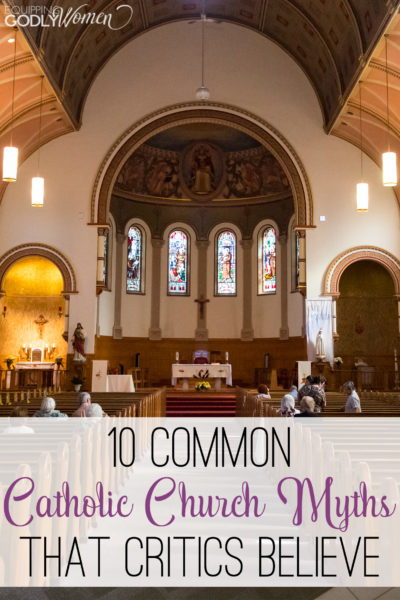
There are lots of wrong ideas about the Catholic Church out there. Are you guilty of believing any of these 10 very common Catholic stereotypes, myths, or misconceptions?
Two years ago, I read a book that would change my perspective on Christianity forever: Surprised by Truth* by Patrick Madrid.
While it (and all of the research I did afterward) wasn’t enough to fully convert me to Catholicism, it did poke some pretty big holes in everything I was taught growing up as a Protestant, and it exposed lots of stereotypes about Catholics that I’d heard.
Things I was so sure of before — basic tenets of my faith — were suddenly glaringly wrong.
It was a pretty tumultuous time, as I reevaluated everything I’d believed my whole life. It was the start of something big, and it was the start of the series you’re reading now.
(You can read the whole series here, if you’re interested.)
Now, two years later, I’m still not fully convinced that Catholic Christianity has it all right. But I’m not convinced they don’t either.
What I do know is that much of what people believe about Catholics and the Catholic church simply isn’t true. Lots of what people “know” aren’t facts — they are Catholic stereotypes that don’t hold up when we dig just a big deeper.
And today, I’d like to set the record straight.
Are you guilty of believing any of these Catholic stereotypes and myths?
*This post contains affiliate links. Please see my full disclosure statement for additional information.
—————————-
A Few Things to Keep in Mind Before We Begin…
1. This post is about official Catholic belief — not what Catholics do in the privacy of their own homes.
What a religion officially teaches and how the people put it into practice are two entirely different things. In this post, I want to replace Catholic stereotypes with accurate information. This post is only meant to talk about what Catholicism actually officially teaches — not what people actually do in the privacy of their own homes or in their local churches.
(There will always be individual people messing things up in every religion)
2. This post is just an introduction to Catholic stereotypes, myths, and misconceptions.
This post is not meant to be an exhaustive guide to everything the Catholic Church teaches and misconceptions about it. That’d be waaaaay too long for a single blog post! It’s simply an overview of 10 of the most common stereotypes about Catholics and their beliefs.
Please see the links below each point to read about each issue more in depth. There are some really great posts in the rest of this series, and they explain these Catholic myths in ways a simple paragraph or two cannot adequately cover.

Want to Explore Catholic Stereotypes in More Depth?
I have a free guide that will help you do just that!
“10 Common Catholic Church Myths that Critics Believe” contains all the Catholic stereotypes from this article so you can print them out, refer back to them, and share them with others.
Plus – it even includes 5 bonus myths not included in this article!
If you are looking for information to help you share with non-Catholic family members OR if you’re thinking about becoming Catholic but you still have some questions about Catholic misconceptions — this is a fantastic resource to have on hand.
—————————-
Alright, let’s dive in!
10 Common Catholic Stereotypes, Myths, and Misconceptions
Myth #1: Catholics Aren’t Christians
Actually, Catholics consider themselves to be the original Christians, who are doing their best to hold to the same beliefs and traditions that the church held to in the first century.
According to Catholics, Catholics and Protestants are all Christians, and both Catholics and Protestants can go to Heaven. The Protestant denominations are simply off-shoots of Catholicism (or of other denominations) that branched off over various disagreements about what the Catholic Church was teaching.
Whether Catholics have held fast to the right teachings throughout the ages or whether they veered off and the Protestant denominations got us back on track — that’s something I’m still trying to discover.
This is a big Catholic myth to kick off this post: Even though Catholic stereotype #1 says that Catholics aren’t Christians, the truth is that Catholics are doing their best to follow the teachings of Jesus Christ (and isn’t that one of the things that makes a Christian a Christian?).
Myth #2: The Catholic Church Abandoned the Bible for Man-Made Traditions
While the Catholic Church does have many traditions that aren’t explicitly found in the Bible, so does every church (and so do you, in your home). Traditions themselves aren’t bad. It’s only when we prioritize them over God himself or when they take us farther away from God instead of drawing us near that they cause problems.
One reason that the Catholic Church has so many traditions is that the first century apostles didn’t write down absolutely every single thing they taught. In fact, John 21:25 tells us,
“Jesus did many other things as well. If every one of them were written down, I suppose that even the whole world would not have room for the books that would be written.”
Catholics do their best to value and uphold both the written and oral teachings that were passed down from the apostles. Protestants look to the written teachings (the Bible) only.
The Catholic Church still highly prioritizes Scripture. It just isn’t their only source of information (and nowhere in the Scriptures does it tell us it should be).
Catholic stereotype #2 tells us that Catholics abandoned the Bible, but the truth is that Catholics use the Bible along with written and oral traditions.
For more on this topic, I’d highly recommend my post Who Has the Ultimate Authority? A Biblical Look at Sola Scriptura. You can also find the explanations for many common Catholic traditions in Why Do Catholics…? Honest Answers to Your Burning Questions.
Myth #3: Catholics Worship Mary / Saints / Statues
It’s easy to see how some Catholic stereotypes (like this one) got started, but again, it really is just another of many misconceptions about the Catholic Church.
Catholics do not worship Mary or statues; they worship God alone.
Instead, they “venerate” Mary, which, according to Google, is just a fancy word for “regard with great respect.” Similar to how we would show great honor or respect to a King or Queen, without actually worshiping them, Catholics hold Mary and other saints in high esteem as good examples of how to live a faithful life.
Yes, to Protestants, the practices definitely look like worship, and it’s easy to understand why this Catholic myth is still around. But since worship is an attitude of the heart, I don’t think you can “accidentally” worship someone and not know it. If Catholics’ hearts are in the right place — and they only want to show honor — then it’s not worship.
And it’s the same with statues as well. Catholics don’t worship statues. Instead, they are used as decorations to help Catholics remember people who have gone before, similar to how you might put pictures of your friends and family on your wall, or even a baseball card collection you may have had as a kid.
You look at them, you remember them, but you certainly don’t worship them.
They’re just decorations or teaching instruments meant to inspire faith.
Sure, Catholics might have statues and talk about saints who lived a long time ago. But contrary to Catholic stereotype #3, the truth is that Catholics honor Mary and other examples of faith (even with statues!) while saving their worship for God alone.
*For more information on this, don’t miss my post Do Catholics Worship Mary, Saints or Statues?
Myth #4: Catholics Believe People are Saved by Works
The Catholic Church does NOT teach that people are saved by their works. In fact, the catechism of the Catholic Church actually specifically forbids this notion.
Rather, the Catholic Churches basically teaches that, “If you call yourself a Christian, but you don’t act like it, maybe you’re not really a Christian after all.” Or, “Yes, God saves you through faith, but it’s a living faith that naturally produces good works.”
This Catholic teaching is actually 100% Biblical (here are plenty of Bible verses that support it), and is even taught by some highly respected Protestant/non-denominational pastors, including the most Godly man I’ve ever heard speak, Francis Chan.
This widespread Catholic stereotype #4 says that Catholics believe they can get to Heaven by earning it through good works. The truth is that Catholics see good works as the Spirit-inspired fruit of a heart saved by God’s grace alone.
*For a more in-depth look at this topic, please see my other posts Is Faith Alone Enough? and Are You a Christian? Are you Sure?
Myth #5: The Catholic Church Added Books to the Bible
The books that are currently in the Catholic Bible are the same books that the church has recognized as being in the Bible for centuries. It wasn’t until the 16th century that Martin Luther and the Reformers moved them to the appendix, before they were ultimately taken out.
(For the record, Martin Luther wanted to remove James, Hebrew, Jude and Revelations as well, but was unsuccessful. The books that he did remove are called Tobit, Judith, 1 and 2 Maccabees, Wisdom of Solomon, Sirach, and Baruch.)
Whether or not the additional books should have been left in or taken out — I don’t know. I wasn’t there. Guess you have to ask yourself if the early church could have been wrong for 1700 years and the Reformers knew better than the earlier Christians did.
Either way, I’ve read through all these additional books, and there really isn’t much surprising in them. They read like pretty typical Old Testament books. There are a few verses about praying for the dead, but other than that, I don’t recall reading anything that stuck out as especially “Catholic.”
This Catholic stereotype #5 is a doozy because the truth is actually the opposite — one man decided to take out some books that had been in the Bible for over a thousand years.
*For more information, don’t miss my post on Martin Luther, the history of the Catholic Church, and the Bible books issue.
Myth #6: Catholic Priests Can’t Be Married
(Some) Priests are married! Some even have children and grandchildren. (This happens when a man is already married and a priest in a different denomination and then converts to Catholicism later.)
And of those who become priests the usual way and aren’t allowed to get married–not all of them even want to be. Priests know what they’re signing up for. No one is making them be a priest. They have a choice between God and a wife, and it is their choice to make. No one is forcing them to choose one or the other.
Catholic stereotype #6 is in fact the general rule — but the bigger truth is that the path of some Catholic priests does allow them to marry a woman. And those who don’t often consider themselves to be married to the church, the Bride of Christ.
*For more information, read my post on priests, the Pope and confession.
Myth #7: Catholics Recrucify Jesus at Mass
I haven’t heard this Catholic misconception in real life, but apparently it’s popular. Catholics do not re-crucify Jesus at Mass.
Instead, they believe that Jesus and the crucifixion occur outside the limits of time (because God can do cool stuff like that), and so when they celebrate Mass, they are only making the sacrifice (which has already occurred) “present” on the altar.
While Catholic stereotype #7 imagines Catholics as recrucifying Jesus at Mass, the truth is that Catholics believe they are making the eternal reality present in our non-eternal timeline at Mass.
*For a very interesting and in-depth look at the Eucharist, be sure to check out my post Is the Eucharist Really Just a Symbol? 5 Convincing Proofs that Say that It’s Not.
Myth #8: Catholics Believe Only Catholics Can Go to Heaven
While Catholics do believe their religion is the one true religion and the ordinary (most common) means of bringing people to salvation, it is a common Catholic misconception that they believe this is the only way. Instead, they recognize that God can use any means He wants to to bring people to Himself, including those other than the Catholic church, especially if the person has never had the opportunity or knowledge to join the church.
They believe that Protestants who have no reason to suspect their beliefs are incorrect can go to Heaven, as well as Protestants who were planning to convert before death but hadn’t done so yet.
Furthermore, Catholics do not believe you can say with 100% certainty who will go to Heaven (though you can have a good idea) simply because God is judge and we are not — and who are we to presume to know His thoughts?
Even though Catholic stereotype #8 imagines Catholics as very close-minded about the salvation of others, the truth is that Catholic teaching leaves lots of room for God’s grace to work in every single person’s salvation.
Myth #9: Catholic Priests are Child Molesters
Yes, the Catholic church has had huge and horrible scandals in which some priests were molesting children. This was absolutely awful and shameful, and they will have to stand before Jesus for what they did. That part is not one of the myths about the Catholic Church.
But if you look at the statistics, only a very small minority of priests were involved, and it isn’t really fair to blame the entire Church or dismiss the Church’s core teachings for what a few did. Scandals like this happen in EVERY church and in every city. That doesn’t make everyone guilty of the crimes of a few, and it does NOT mean that innocent Catholic priests deserve negative treatment today because of this stereotype.
It is heartbreaking that Catholic stereotype #9 does have some truth to it — some Catholic priests have molested children. But the truth is that the vast number of priests are men who serve God humbly and who shepherd their flock instead of harming the sheep.
*For more information, be sure to check out my series post on priests, the pope and confession.
Myth #10: The Catholic Church is Anti-Women
The church isn’t anti-anyone. They do believe birth control is morally wrong — the same thing every denomination believed until 1930. But when pretty much every other denomination began to change its mind, the Catholic church held its ground on this teaching. They continue to teach the same thing today, even when this gets interpreted as an “anti-woman” Catholic misconception.
The Catholic church also doesn’t allow women to be priests, which has upset many. But if you look at their rate of women in non-priest leadership positions, it is WAY higher than average. The Catholic church may not do things the “feminist” way, but they do hold women in very high esteem, even referring to them as the “crown of creation.” That’s pretty special if you ask me 🙂
So while Catholic stereotype #10 paints the Catholic church as an “anti-woman” institution, the truth is that many women are in leadership positions in the Catholic church, and the Catholic church holds women in very high regard.
Like I said earlier, the intent of this post is ONLY to dispel a few stereotypes about Catholics so that, going forward, your thoughts and opinions aren’t swayed by misinformation. I’m not trying to convert or persuade, just to present you with some information about Protestant and Catholic beliefs so YOU can make an informed decision of your own. 🙂
Ready for more? You can read through the rest of the posts in this Catholic vs Protestant series here OR see what I ended up deciding in my latest Catholic update post here.
I’d love to hear your thoughts and opinions on these Catholic stereotypes and myths, or others you’ve heard! Leave me a note (or a book 🙂 ) in the comments section below!
—————————-
Ready for More?
Honestly, these 10 stereotypes are just the start. Download the print version to get a handy guide you can refer to later or share with others AND get 5 bonus Catholic myths that aren’t included in this article!






Nicely done! I look forward to readin your future posts.
I would also highly recommend a series on EWTN called the Journey Home. You can watch episodes on their website as well as You tube if you don’t get their channel. The host is a former Protestant minister and he has converts on the show to tell their story.
Hmm…. I’m not sure I’ve heard of it–I know I haven’t heard of the host. Thanks for sharing! I’ll have to check that out!
Quite welcome! Another great resource is Scott Hahn’s Reasons to Believe(and anything else he has written for that matter). He is another convert and in this book he covers just what you are writing about : the common objections/misunderstandings about Catholicism. May God bless you along your journey and thank you for having the courage to seek truth!
I’ve heard of him–haven’t heard of that book… sounds really good though! Will have to check it out. Thanks 🙂
I must second the recommendation for “The Journey Home” and Scott Hahn’s books. I can’t tell you how many episodes of “The Journey Home” I’ve watched on YouTube and it’s updated with new episodes as a podcast once every two weeks or so on the EWTN app. I also love to listen to “Open Line” podcasts over the app (I have an hour long commute, so there’s plenty of time to listen to these shows). It’s really interesting to hear the questions that people pose and to hear the responses. Ignatius Press also has an app with several free downloads of Scott Hahn’s lectures.
Thanks for the recommendations, Leslie!
I’ll add my accolades for The Journey Home as well! When I mentioned previously that I enjoyed hearing people’s conversion stories, I was specifically thinking of that program, and of course Scott Hahn’s, “Rome Sweet Home”, as well! I think I have learned more from listening to other people’s questions and discoveries than I have learned from family that were born and raised in the Catholic Faith. Great second post in the series Brittany! Now I really need to get off of your page so I can tackle my list for the day, lol! God Bless!!
Just put “Check out all of the awesome posts on Equipping Godly Women” ON your to-do list! Ta da! One thing done already 😉
Another one is Crossing the Tiber by Stephen Ray, another Convert.
Hey I have a couple questions in regards to Mary. I’ve heard that it is a Catholic belief that Mary herself was a virgin birth as otherwise woman was too evil to carry Christ, that she was sinless and remained a virgin. Are these things true? I’d have to say these are my highest points of disagreement. Especially as scripture mentions that Christ had siblings.
No, Catholics do not believe that Mary was a born of a virgin. We believe she was immaculately conceived-born without original sin. Yes, Mary was sinless and remained a virgin.
If Mary never sinned, then why did she make a sin offering at the Temple, and why speak of ‘her savior?’
She made this offering out of obedience to her faith. This is another reason why Catholics regard her so highly because she is a great example of obedience to God.
Hi Joy…as a lifelong Catholic, here is what I have always been taught about your question. No, Mary was conceived in the usual way. But, she was conceived WITHOUT original sin. This was because she was to be the mother of our Lord, and that vessel (womb) was to be immaculate, as it was to be the home of the Son of God for 9 months. She remained a Virgin so as to not defile the dwelling place of Jesus. She was the original tabernacle, as her body contained the living God. She is not, nor was she ever worshiped by Catholics, as we believe only God is worshiped. She is revered and honored because she said “yes”. Also, someone wiser than I once said…”Don’t be afraid of loving Mary too much. You can never love her more than Jesus did.”
This is what I’ve heard as well. Thanks for the clarification.
Catholics do not believe that Mary was born of a virgin. They do believe that she remained a virgin, and we’re addressing the details of that on March 4th. (Don’t worry–it’s actually a really simple explanation!)
Since the Immaculate Conception of Mary have been addressed sufficiently, I will give a short clarification to the ‘siblings’ of the Lord, which flows over into the Perpetual Virginity.
The interpretation and understanding that the Virgin Mary had other children and was involved sexually with Joseph is very modern (last 2 or 3 centuries). Even the original Reformers (Luther, Calvin, Zwingli) held to the ancient Catholic and Orthodox beliefs.
We must realize the limitations of Aramaic as a language, there was no word for cousin. So the word brother is/was commonly used for that purpose. Even in English the word brother is used to describe relations that are non-blood founded.
Mary had been consecrated at birth to the Lord, and spent her youth in the temple. She had to leave the temple when she began menstruating because of the laws of the time. There was the need for someone to be her guardian; a righteous man. So she was entrusted to Joseph, who could have been a widow with children. IT would be unthinkable for Joseph, as a righteous Jew to even touch Mary in any way that would desecrate her. One way to see this today, would be a woman that consecrates herself to God in a convent and remains a virgin her whole life.
Anyway, a lot of what we know about Mary comes from the Protoevangelium of James, Luke’s Gospel, and some bits from the Church Fathers. Additionally, from some of the very early liturgical prayers. Let’s be aware that the Liturgy existed before the any of the books of the New Testament were written.
Luther: Throughout his life Luther held that Mary’s perpetual virginity was an article of faith for all Christians. “It is an article of faith that Mary is Mother of the Lord and still a Virgin.”
Calvin: “Helvidius has shown himself too ignorant, in saying that Mary had several sons, because mention is made in some passages of the brothers of Christ.”
Zwingly: “I firmly believe that Mary, according to the words of the gospel as a pure Virgin brought forth for us the Son of God and in childbirth and after childbirth forever remained a pure, intact Virgin.” Zwingli used Exodus 4:22 to defend the doctrine of Mary’s perpetual virginity.
I am a cradle catholic and quite traditional. I love your site and am happy to sign on. I know I can learn a few things from you. God bless you and keep up the open mindedness. It is a beautiful thing.
Larry P
Thanks Larry!
Oh! Also Indulgences! I have a huge issue with indulgences! (And so did Martin Luther if I remember correctly) Particularly the earning of indulgences. Or even the selling of them as what was going in the time of Martin Luther. I was horrified to see the Pope putting out something about granting indulgences for tweets or something like that awhile ago. I’d hoped they had left that practice to the dark ages where priests would go about with people hunting the condemned in order to sell them indulgences before their execution. I would love a Catholic view on indulgences. My understanding of them is that they are basically a buy off from time in purgatory. Oh, and purgatory, that is another whole area I’d love some clarity on from a Catholic view on!
Joy, I’m sure Brittany will answer you as well, but I’ll encourage you to visit a Facebook page that I manage called “Ask a Roman Catholic” (ARC) https://www.facebook.com/AskARomanCatholic As a convert to the Catholic faith and a professional Catholic musician and liturgical minister, I have lots of information at my fingertips and I’ll be happy to provide additional answers as I’m able. Another excellent website is Catholic Answers:www.catholic.com Thank you for asking good questions and seeking truthful answers!
Thanks for the resources! I’ve heard of Catholic Answers; I’ll have to check out your page as well.
lol. I need some more clarification on this too! We actually just talked about it in RCIA this week, but it was more an explanation of what it is rather than the why behind it. I will definitely be meeting with the Priest again for more clarification on this, and that post is scheduled for March 18th. (Did NOT know about Tweets. That’s funny.)
Me neither. That has to be a joke from the pope. He does have a very playful side at times, while extremely deep.
Indulgences are simple and complicated. Abuses on this area existed in the past, but all that is gone.
Scott Hahn a few years ago did a fairly long presentation on indulgences, and he was uncertain if he had done justice to the subject.
Purgatory is a subject which I do a long presentation. It was one of the sad outcomes of the Reformation. The disbelief in Purgatory has had many sad ramifications.
That “priests would go about with people hunting the condemned in order to sell them indulgences before their execution” is a brand new one for me, and I thought I came across them all. Sound like Urban Legend.
Joy, today indulgences are a gift received by an individual due to an act of faith; when one turns more fully toward God and away from the world. So, what does it accomplish in regards to purgatory? I think it is safe to think of it this way: If you or I were to go to heaven right now heaven would no longer be perfect (as you and I still have sin and imperfection in our lives). Purgatory can be thought of as the purging of imperfection or more positively as the bringing to fulfillment of the person. By the way, it really is unknown if this happens within time or is outside of time or instantaneous, we will get those answers some day. Hope that helps.
Ps. They are not purchased at a price, that was an error in the Church. We must remember that although it is believed that the Church holds the fullness of Truth and is guided by the Holy Spirit it is staffed by human beings and trapped in time and the Truth is not fully appropriated at any given time, by anyone. We all make mistakes and this has since been condemned and corrected.
Indulgences were never sold by the Church. The way the system was setup it made it easy for certain corrupt prelates (bishops and priests) to manipulated the ignorance of the people. That was one of the areas that underwent reformation to prevent future abuses. Also, there is much controversy about what Luther claimed and what was truly happening in that area.
Anyway, the indulgence abuse, in a way, resembles the sexual abuses and scandal that we witnessed recently. The Church has always taught that it is sinful behavior, a mortal sin (fornication/homosexual acts). Additionally, the priests/bishops broke their vows of chastity (akin to committing adultery in a marriage). This amounts to a double sinful act.
Just like in the 16 century with indulgences, the Church has implemented reforms, unlike ANY OTHER institution in the world (based on secular observations) to address and prevent this from reoccurring.
Hope this clarifies some things.
It is within time, Rod. That is why the Church uses the word ‘temporal’, which comes from time. Purgatory is a continuation of the purification of those not worthy of Hell (repented of their sins, or have minor , venial, sins, etc) but not ready for Heaven. What we don’t know is the ‘type’ of time, since it enters into a different ‘dimension’ of God’s universe.
Additionally, St Padre Pio, the most charismatic man of the 20th century (endowed with charismatic gifts that resembled the apostle days) said: When I am done with my Purgatory …”. In order to be canonized he had to be in Heaven already.
Our Lady of Fatima answered a request from Sister Lucia, one of the three visionaries, about two girls she knew that had passed away. The Virgin replied that one was already in Heaven and the other (I think she went to Communion in mortal sin) would be in Purgatory until the end of time. This means that the stay of one was very short or none because she lived a very holy life, and the other is still in Purgatory until the Second Coming and the Resurrection of the Dead. That could be many centuries still.
Hope this clarifies.
Joy.
Briefly:
Indulgences. When we repent of our sin God in his mercy frees us from the eternal punishments (hell) that we deserve because of them. Because of his justice we still have to live with the temporal consequences (I kill someone and then repent they are still dead). Part of repentance is a desire to make restitution. Because of sins ripple effect I can’t make restitution for my sins. Christ, however, can. An indulgence is a way we unite our prayers and works to those of Christ so that our desire to make restitution can be fulfilled.
Purgatory. Think of your relationship with God right now. Is there room for improvement? Are you yet perfected in Christ or is there still room to grow in grace and virtue? If the answer is yes then what happens if you die right now? Are you stuck forever “on the way”? Catholics believe that God’s work of sanctification doesn’t end when we die but continues to perfect us until we are truly perfected in Christ. That experience of being perfected in grace (and “purged” of whatever attractions to sin we still might have) is Purgatory
Brittany, may God bless you richly for your generosity in sharing these points! Your open-mindedness and sincerity are refreshing, and consistent with our Lord’s desire that “they may all be one.” The disunity of Christians is a great scandal that is many centuries in the making. Let us continue to pray for its reversal! I am a former Protestant (United Methodist) who married a Catholic, and have had my own journey of discovery. Now over 20 years after coming into full Communion with the Catholic Church, the joy of discovery is greater than ever before. The life of daily grace from living a fully Catholic life is beyond description – well, its a little bit of heaven on earth! I pray that your journey will be filled with joy and the support and encouragement of others.
I keep hearing this “joy of discovery” and richness of the “full Communion into the Catholic Church” — lol, I feel like I’m missing something because it’s still very much a head/logic thing for me at this point. Right now, I’m investigating into the truth and hoping to inspire others to do the same. I have yet to embrace Catholic culture 🙂
Hi Brittany – thank you so much for writing this article!! I am currently in a similar situation. Raised Protestant, grew up extremely active in church. I was at church with my mom 3-4 days/week when I was younger helping with church events, bible school, Sunday school – all the things that I loved growing up and really formed my faith. We moved around some and always went to the church with the most engaging youth group and sermons – so I would say I grew up “christian” not baptist, Methodist, Lutheran, e-free or Presbyterian (even though I had been a part of them all! :-)). We used to joke we “were everything but Catholic because they wouldnt let us take communion” I think a big of part of why we could “jump around” so much is that we never really dove into the theoretical differences of the churches. Two years ago, I married into a Catholic family. Although it caused some tension, I told my family I would rather marry a “strong catholic than a wishy washy Christian”. For the last two years we have been doing double duty – Mass on Saturday night and a Presbyterian church on Sunday morning. However, I know this is not sustainable. We are planning on trying to start a family in the next couple of months and it is on the list of “must figure out” before any pregnancy announcements. My root issues on conversion are derived out of concern for our kids… will they be able to be engaged? The mission trips, bible study groups, and engaging youth groups were so fundamental for me and my relationship with God growing up – am I depriving my kids of the same opportunities? I have seen so many people become disengaged with the Catholic faith due to the emphasis on rituals and history and not how it could apply to your life, say as a 13 year old. My other large concern is, from what I have seen, is the lack of emphasis on the relational element with God the father. Its ok to just “talk to Him” and not have to have a formal prayer around it. I want my kids to have a relationship with God and am nervous on how that will transpire in the Catholic faith. I am really looking forward to going on this journey with you and what you discover! Thanks for taking the time to write this blog!
Thank you so much for sharing your story! I definitely laughed at your “we “were everything but Catholic because they wouldnt let us take communion”” line and agree 100% with your “I would rather marry a “strong catholic than a wishy washy Christian”” line.
People have asked me several times as well how my husband and I can be married when we don’t believe the same thing–how that works. But honestly, I feel like our beliefs are very similar. We agree on all the day-to-day stuff and all of the most important things, it’s just the deeper theological stuff that we believe differently. And I figured by the time the boys got to that–they could chose for themselves. It isn’t anything that is going to put their salvation at risk. I’m fine with them being raised Catholic.
I completely understand your worry about kids (and people!) being engaged. I think that is really something that starts at home though. With service in your community (I have a TON of articles on that) and living out your faith in daily life. Also, if your kids go to Catholic school, they should find some good community there. And apparently Catholics do have Bible studies too! Who knew? lol
Concerning prayers: the priest at our church said talking to God directly is a higher form of prayer than Scripted prayers and praying the scripted prayers is not really necessary–Catholics just like to pray them. (but you don’t have to)
Concerning seeing God as Father: again, can be taught at home 🙂
IF I may add to what Brittany said.
The highest form of prayer a Catholic has is the Mass. The Mass is THE prayer of the Church, and almost exclusively a prayer to the Father through the Son. So, to say that we don’t really have a relation /prayer with the Father is another ‘appearance’ that is not real.
Additionally, there is no higher form of intimate relation with Jesus than through the Eucharist, or Adoration of the Blessed Sacrament. Not all Catholics ‘listen’ and get involved/participate in what is going on in the Mass, which is extremely sad; body count.
It was always my concern to teach my son to be attentive and actively involved in the prayers of the Mass. As a father, during his Baptism, I made a vow to God to raise him Catholic. It became MY responsibility to teach him the faith, so every thing else that can complement my teaching is a bonus.
I remember my double-duty when I lost temporarily my wife to the Assemblies of God; late 90s. Since I have held various ministries in the Church, but mostly music, I see a lot of families and their behavior. I witness weekly some that act like ‘air-head’ young adults, while others from a different segment of the same family (married with their own children) have a love and devotion that is palpable in both the parents and children. This means that two married brothers and I watch the behavior of the fruit; HUGE.
My recommendation, Jone, is for you to give the Catholic Church a real and honest shot. If what she claims pans out, then follow the truth where it leads you, and take upon yourself to learn and LIVE the faith. Then pass it on as a parent whose most important goal in life is to raise God-loving children, who will be with Him for all eternity.
Adding to the first part, about a relation with the Father. Beside the Mass, when I pray the rosary I pray six Our Fathers (the Lord’s Prayer). So my heart and thought are lifted up to my heavenly Father at these moments as I pray and meditate on the words. When I pray the Chaplet of Divine Mercy, my heart is continuously in prayer to the Father, since it is (in a sense) an extension of the Holy Sacrifice of the Mass.
Jone, since your roots are Presbyterian, I am going to recommend some people that are more specific. I recommend Scott Hahn, Marcus Grodi, Peter Kreeft. All were Presbyterian ministers before finding their way into the Catholic Church.
Additionally, others like Jimmy (James) Akin, Steven K. Ray, Tim Staples, Patrick Madrid, Dave Armstrong, Karl Keating, are excellent and solid in teaching. Of this list only two are cradle Catholics. Here are some links that may facilitate part of your search:
http://www.chnetwork.org and http://www.youtube.com/user/ComingHomeNetwork
http://www.salvationhistory.com
http://www.jimmyakin.com
http://www.catholic-convert.com
http://www.catholic.com
http://www.patrickmadrid.com
As a cradle Catholic I have to admit I completely understand where your concern for being engaged comes from. I think that for years we as Catholics have been too comfortable with believing what we believe but not searching for why we believe it. In our comfort we have lost some of our youth. Shame on US for now doing a better job at staying connected with our youth! I have to say youth is a huge passion of mine and not just in the go to class on Wednesday night and memorize what we believe. But rather, come to class on Wednesday night and question what we believe! If I don’t know the answer I will search with you, but the time has come for Catholics to stop being comfortable and waiting for everyone to “come around”. It is our God given responsibility to reach out to others in any way that we can. Please know that there are some parishes that do a much better job at reaching out to youth than others. If your current parish isn’t great at it, step I and take that role, or find a parish that is better. Prayers for you on your journey!
I agree! Not in a mean way, but I’ve definitely noticed that Catholics seem more content to just be who they are and wait for others to “see the light” while Protestants are more likely to go out and verbally and intentionally evangelize. Of course, this is only based on my own personal experience, not every person everywhere, but that’s what I’ve seen. Protestants are more defensive, more evangelical and more likely to read the Bible for themselves (whether or not they get the meaning correct….) But there’s no reason it has to stay that way!
You must not have met my group of friends! Haha! But in all seriousness, I recommend reading Pope Francis’s homilies (equivalent to a sermon). He has some great things on being joyful and spreading the Gospel as a joyful people.
First of all, can I hug you through the computer for not speaking Catholic-ese?? 🙂 I actually have figured out what homilies are now, but it’s just one of a LONG list of words that I have NO idea what they mean and Catholics never seem to realize that! Candidates? Catechumens? I know what they are now, but it’s like they are TRYING to make things as difficult to understand as possible! lol
Jone,
I became Catholic last year, and it’s awesome! There is always something going on for everyone in the family. We live in a very active Catholic community, but you have to be involved with the Church to really see what all they’re doing! There’s Knight’s of Columbus events, Church picnics, sending kids on trips to -world youth day, there are places to go around the globe for trips on Church history, visitations, see where Saint’s have lived. There are a lot of councils, and regular milestones with catechism that will be taking place for all of the children. There are as many activities as you want, and if not – talk to your Priest or Deacon- every Bishop wants and has a duty to engage the youth of their flock and they’ll help guide events or starting of a Youth Program (I bet the Church has one, and it is active- with service projects, camps, etc.!)
I went the same process a few years ago when I was in the hospital, watched EWTN, and actually liked it. This got my curiosity going and I spent a couple of years trying to understand and evaluate Catholicism. I will summarize some of my thoughts here.
(1) Most of the traditional Catholic / Protestant issues they bicker about is over hyped. For example, while I do not..nor do I advocate..praying through the saints..neither do I see this practice as a great evil. Similar for other Catholic stuff like Mary, purgatory, etc.
(2) Properly understood Catholicism is not salvation by works. They may be more Wesleyan than some might prefer, but Calvinism / Arminianism is an internal Protestant debate and nobody is claiming Methodists treat salvation by works.
My big issue with Catholicism are the implicit and explicit claims of superiority. This stems in my opinion from the Catholic claim to be exclusively the Church of Jesus Christ, which means that everybody else is of some lesser status. If you read their literature the claim is that Protestantism is heresy while Orthodoxy is schism.
Their claim to be exclusively the church of Jesus Christ appears to be based on lineage, the unbroken chain of popes from St. Peter to the present. If these claims are in fact true, then everything else I may or may not have issues with can logically follow. However as I thought about them I was troubled.
I then boiled my being troubled down to one question.
“For us living here and now in the 21st century (where we can look in the phone book and see many organizations under the label Christian), did God give us clear instructions that only one of these organizations would really be his church that we really should be a part of. And if he did so, how would we know which one.”
Note that this question is not the same as (1) Did God found one church (yes). (2) Did he found it on St. Peter (maybe..maybe not..depends on Greek interpretation that is not my expertise..but for the sake of argument I will say yes), (3) Is the church existing in many organizations as we see today his design for the church (unlikely if I am understanding John 16 correctly so I will say no).
I also noted that the claim of exclusivity did not pass the smell test. I just don’t get the sense that the Catholic Church is superior. Instead I get the sense we are all about equally messed up..albeit differently.
Finally I read that to be a Catholic you have to believe all that the Catholic Church teaches. Since I did not believe the Catholic church was exclusively the Church of Jesus Christ, I could not go there.
I could not honestly answer question 1 in the positive. And even if I could I would then be stuck on 2.
Really enjoyed reading this. I also have trouble with the Catholic church claim of superiority. In practical terms, it boils down to this for me: my son is not perfect, but is one of the purest souls I know, and he dearly loves Jesus Christ as his Lord and Savior. He is married to a catholic woman (who also is a devoted Christian), yet her catholic church judges my son to be unworthy of receiving communion. It doesn’t matter to her church that he is a Christian. Apparently that’s not enough. That judgmental practice really, really bothers me!
I can see how that would bother you, Julie! It’s really not a matter of being “unworthy” though. I’m writing all about the Eucharist next week (Wednesday) and I will make sure to mention this point specifically. I hope you will check back!
Julie,
I can see this is troublesome to you. Know that the Church’s denying him Communion is out of love, not out of judgement. In 1st Corinthians (starts at 11:23) Paul clearly warns everyone of taking of the Body & Blood of Christ in an inappropriate manner, to ensure everyone knows of the requirements (and agrees with them) the Church has an education process-Rite of Initiation for Christian Adults (RCIA). It’s not to deny people Christ!, but to ensure they do not “profane the body and blood of the Lord …or eats and drinks judgement upon himself.(11:27 & 29)”
Hi Julie!
I’m sorry that you feel your son is being judged unworthy. That isn’t at all what it
Is going on, though. If you’ll give me a chance to clarify, it might help with some hurt feelings.
If you had, in your possession, the most treasured and valuable jewel in the world, the only people you would let hold it would be those who understood the value and cared for it as you did. That is how the Church views the Eucharist.
We Catholics believe in the True Presence of Christ in the Eucharist. We get this from the 6th chapter of John’s Gospel. We believe that we are literally consuming Christ, and that is the most holy thing we can possibly do. Because your son, as a Protestant, presumably doesn’t believe that, the Church doesn’t allow him to receive communion. The other facet is that by receiving Christ in the Eucharist, we Catholics are affirming the fact that we are in unity (in communion) with the Catholic Church.
I hope this helps clarify it a little bit. Many prayers for you and your son, and his family! I can’t imagine it’s easy to have a mixed-religion marriage, so good for them for making it work. 🙂
Brittany, I’m looking forward to reading about your studies of the Catholic faith. Thanks for the post!
Thanks, Micaela!
Hi, Julie! Just wanted to let you know that, as promised, my post on the Eucharist is finished. I hope it sheds some light on the issue. I purposely put a section on this issue in it, along with a few additional resources that will hopefully help. You can find it here: https://equippinggodlywomen.com/faith/is-the-eucharist-really-just-a-symbol/
1. I don’t think Catholic practices such as praying through the saints are evil either. Just don’t really understand it at this point. It hasn’t “clicked,” I guess?
2. Agreed.
Re: Catholic superiority: I’ve always taken the view that most denominations are just variations of essentially the same thing, and since you can’t tell which is 100% true (probably none of them), you just have to do your best.
Really, my purpose here isn’t to argue that Catholic or Protestant is right in a way that anyone should just “pick one” but just to examine some core beliefs/differences to find out where the truth lies. I don’t really care about the label–it’s just the easiest way to explain things (usually). If, at the end of this series, Catholic teaching seems to be most correct, I may end up there. If not, I won’t. I don’t know, and it doesn’t really matter so much. I’m just attempting to search out the truth and to inspire others to do the same.
(And the purpose of this Catholic myths post in particular is to remove a few myths so that people can open their minds enough to be able to even address the issues without an unfair bias towards the Catholic church if that makes sense)
And yes, I’m currently questioning how much I have to believe to be Catholic. If I’m in, I’d like to be all in.
You may liken praying through the Saints like me asking you to pray for me to help me quit smoking. We must always remember one thing about prayer, it is not a Christmas list. It is about moving our will closer to God’s, not His closer to ours 🙂 And it is always good to pray for one another.
Wonderful post. My husband and I converted to Catholicism in 1999. I also grew up in the Bible Belt. I had heard all and believed some of these. I am rarely offended when someone accuses the Church of some of these things (except #9) because I have been on the other side. Great post!
Thanks, Laura 🙂 And it’s good not to be offended. It’s better to just educate 🙂
Hello again! I just wanted to share something that had a huge impact on me when I was on a similar path of inquiry. I have always been captivated by Christ’s High Priestly prayer in John Chap 17. Jesus, not long before His Passion, prayed “that they all may be one, as You, Father, are in Me, and I in You; that they also may be one in Us, that the world may believe that You sent Me.” Unity was extremely important to Jesus. It was the thing that was supposed to show the world that He was truly God’s Son, and I think it breaks His heart that there is division among His people. I started asking what a church designed to be centered on Christ and fully unified would look like, and I began testing the various Christian doctrines against this idea. It was very fruitful and shed a lot of light on what the Catholic Church teaches. I would encourage you to keep this prayer of Jesus in mind as you seek what is true.
Blessings,
Megan
That’s a sweet story, and I know we would all like unity, but what I’ve been saddened to hear lately is that even among the Catholic church, there are still a TON of differences. I mean, I suppose it’s to be expected since it is world-wide, but with 23 different rites… the Catholic church isn’t quite as unified as I thought they were either!
Different rites actually are not divisions in the Church, but merely different liturgical forms within Her. All the rites that are Catholic are in full union with each other and profess all the same dogma and doctrines. What is often referred to as “Roman Catholic” is actually the Latin Rite within the Church. It is no more or less Catholic than any of the other rites. Something you will find about Catholicism is that it is big on the “both/and.” So, it is possible to be both fully united and have different modes of expressing our faith through the liturgy.
Right. I was just surprised to see that there are a ton of differences still. I thought they were more unified than they are.
Now that you mention it, Brittany, I can see how different it may seem. Just imagine another diversification, when the Catholic Church added recently (allowed) the Anglican Rite to be used, after some reforms to meet the requirements of the Catholic faith and teaching, because whole Anglican congregations joined the Catholic Church. I truly can see through your eyes how this could seem less unified than what it actually is.
Maybe one way of thinking of the various Rites in the Church would be like having slight variations in the prayers and gestures, but every one believes in the same doctrines (faith) and morals, and are all in union with the Bishop of Rome.
If we compare this with Protestantism just in the Sacrament of Baptism, we see a great variety of belief in what it does and does not. Infant or adult, etc.
The similar scenario, exists in regards to the Lord’s Supper.
Some churches do it every week, while others once a month, others once a year and some never. Some believe to be something identical to the Catholics, while to others it is the bread+Jesus, to others a spiritual union of Jesus with the bread. Yet to another segment it is nothing but more than a reenactment of the Supper. And, of course, this is not all, there are some more in-between shades.
All have the same 7 sacraments, and are all valid. Additionally, they all believe the same thing. This is 7 vs 2 and the 2 have a lot more choices than the 7.
All Rites hold to the same dogmas (unchangeable doctrines), and all are held to the same Moral standards (many dissenters in the pews here).
The books of the Bible were chosen by councils long before Trent which only confirmed the Canon in response to what Luther was claiming.
I like your efforts here. I’m a pretty active Christian debater, and try to be really objective in my assessments. Numerous times I have attempted to correct misconceptions about Roman Catholicism, the first being that what you see practiced does not necessarily coincide with official church teachings. It’s the same in Baptist circles, too, where not everyone believes and practices in accord with their Baptist Faith and Message.
It’s also noteworthy to answer the question – what is Protestantism? The first Reformers sought what the name suggests, reform. They never sought to establish a new version of Christianity, but sought to bring Rome “back” to biblical accuracy, thought to be expressed in Augustinianism.
Lastly, works. Being Reformed Catholics, Protestants have the same bottom line as Catholics when it comes to faith and works. Whether righteousness is infused, imputed, or imparted makes little difference imho, because all 3 views agree that without works a man has no hope of heaven. And fwiw, I’ve read more about grace in the Catechism of the Catholic Church than in any official Protestant Catechism.
Oh, and I’m not Catholic or Protestant. Just an objective onlooker
Agreed.
Agreed as far as I can tell.
And not really. I’ve heard plenty of Protestants vehemently proclaim Faith ALONE, and that was always the understanding that I got. I was really surprised to dive into the Bible myself and see so much emphasis on works that I never saw before. I know that there are several Protestant divisions who would agree on the necessity, but it definitely isn’t all of them…. Maybe after my post on it in a couple weeks, that will change 🙂